New Set-up

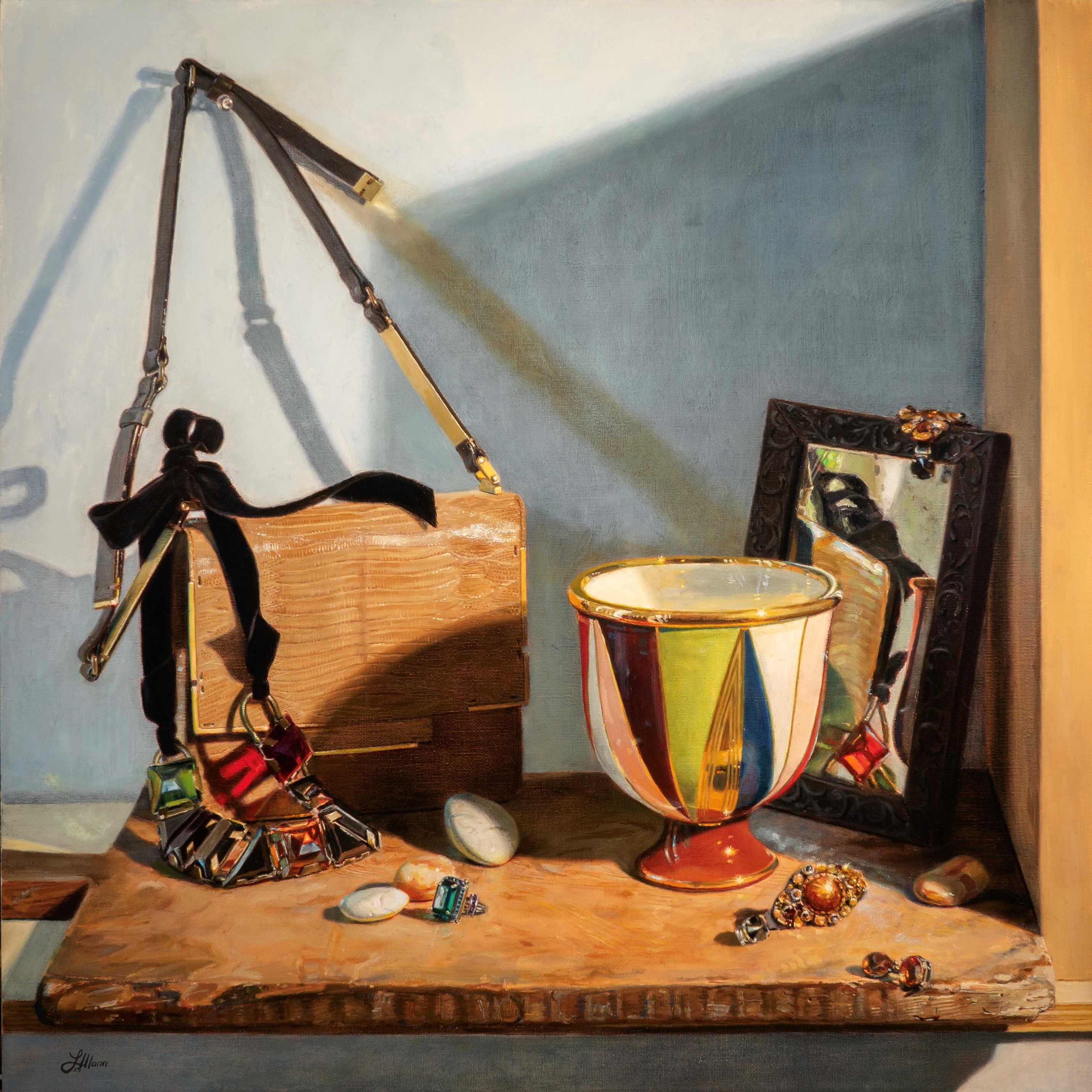
This still life will be the latest addition to my recent series featuring costume jewelry, handbags, and scarves. My starting points were the bag, scarf, and necklace. I liked the way the black triangle on the scarf echoed the black triangles on the bag. I also liked the colors. As a first shot, I simply placed everything on my table with this copper vase, put a drape behind them, and turned on the spotlight. It was promising, but I thought that maybe I needed something in a lighter value to add contrast.

Below, I switched out the copper vase for a light tan clay pot. I also added the box on the right to cast a shadow. I draped the necklace and added the orange jewelry box and ring. I liked the cast shadows. I wondered what the composition would look like vertical instead of horizontal.
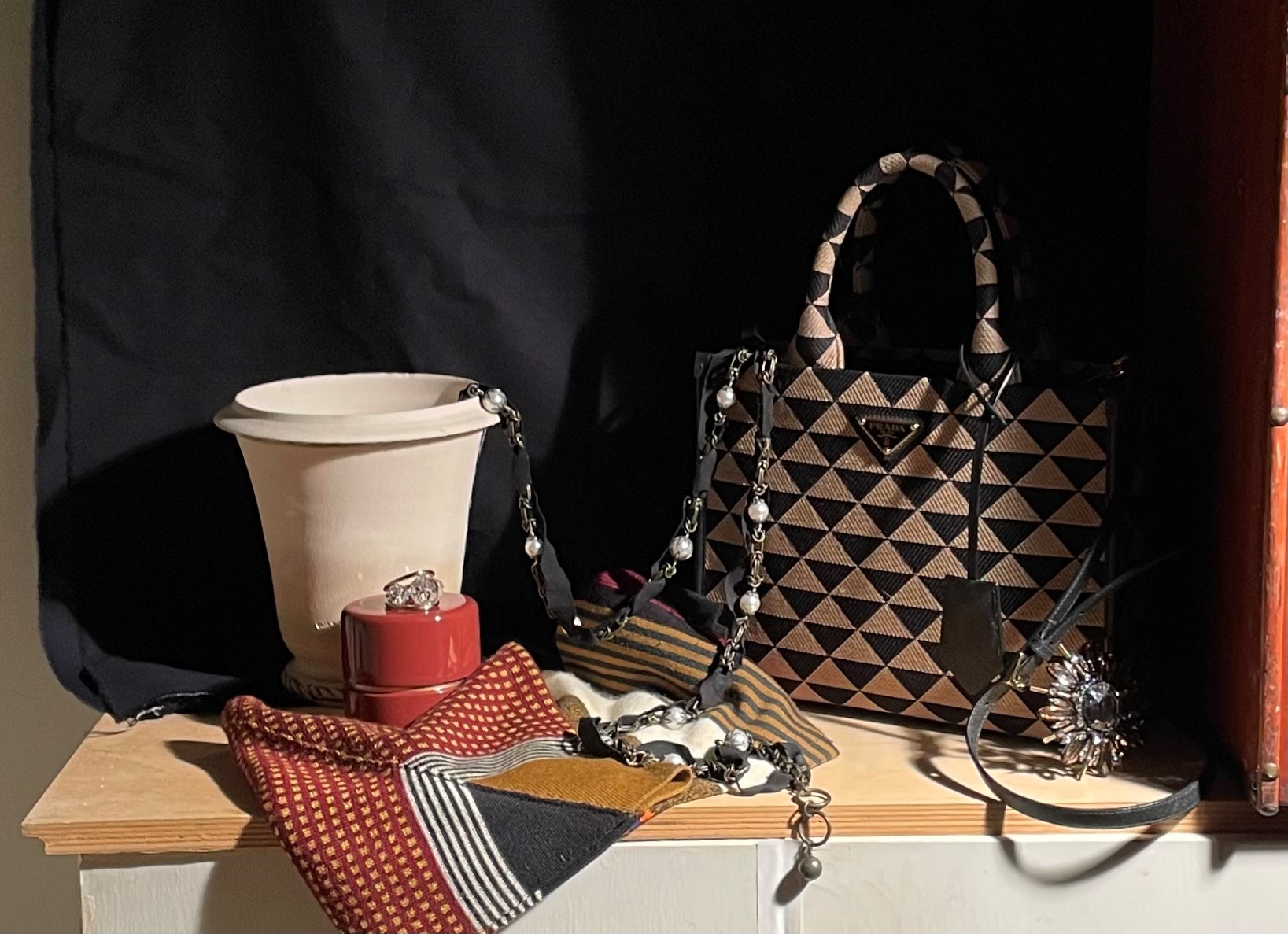
Below you can see what this looked like. I prefer the necklace draped this way. I think that it looks more natural and serves to unify the bag with the scarf and necklace. I also draped the handbag’s shoulder strap up to the right.
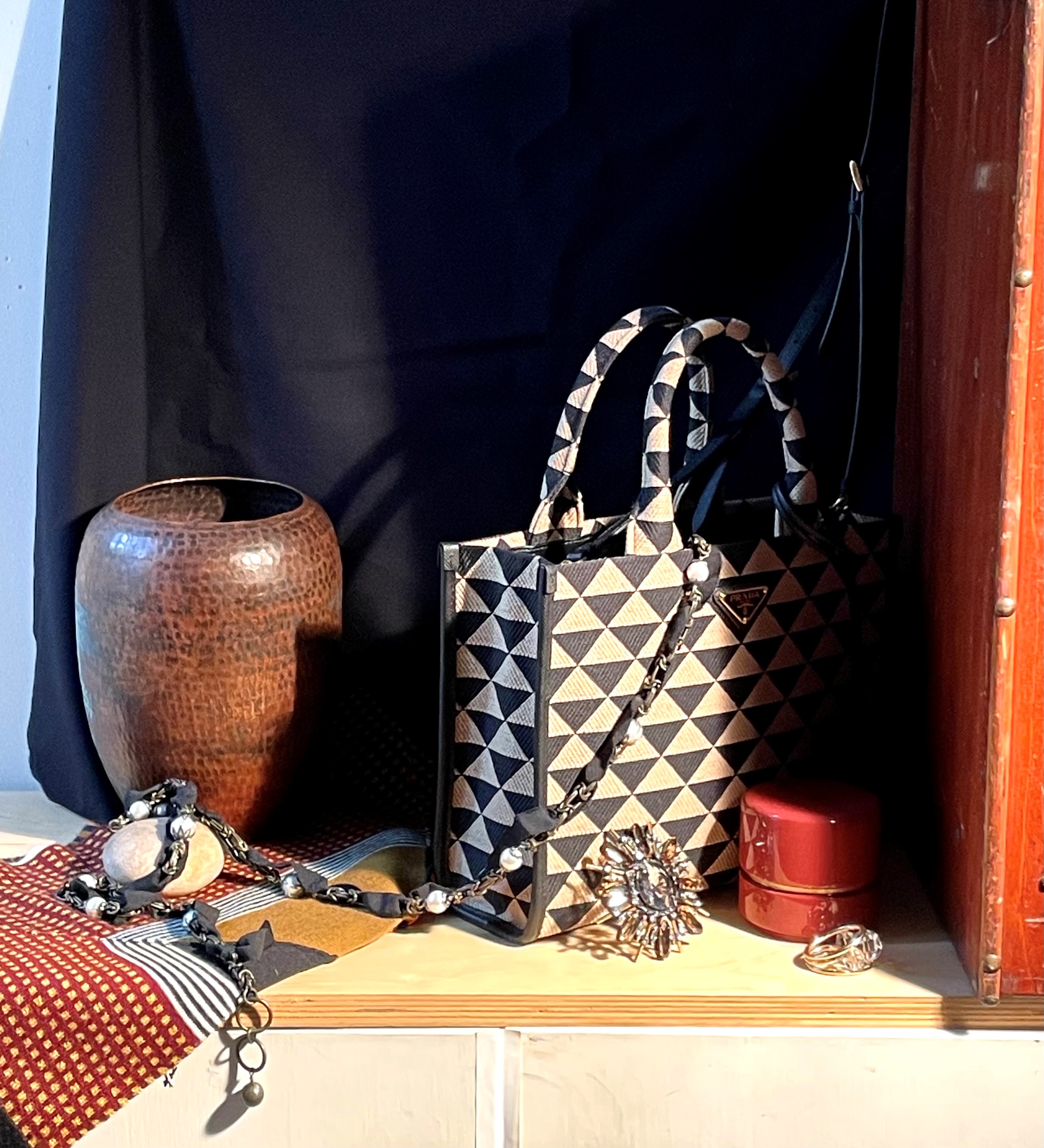
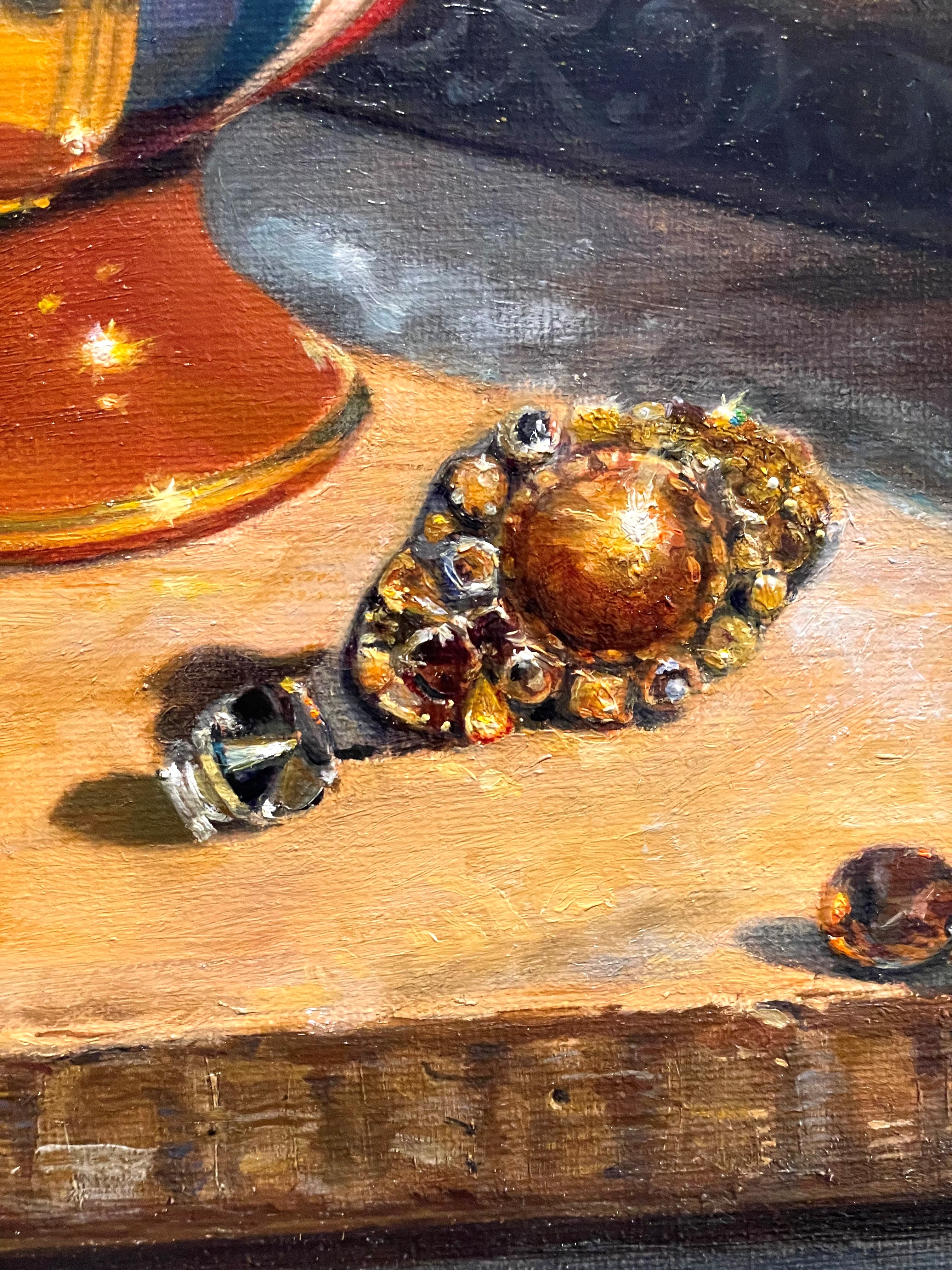
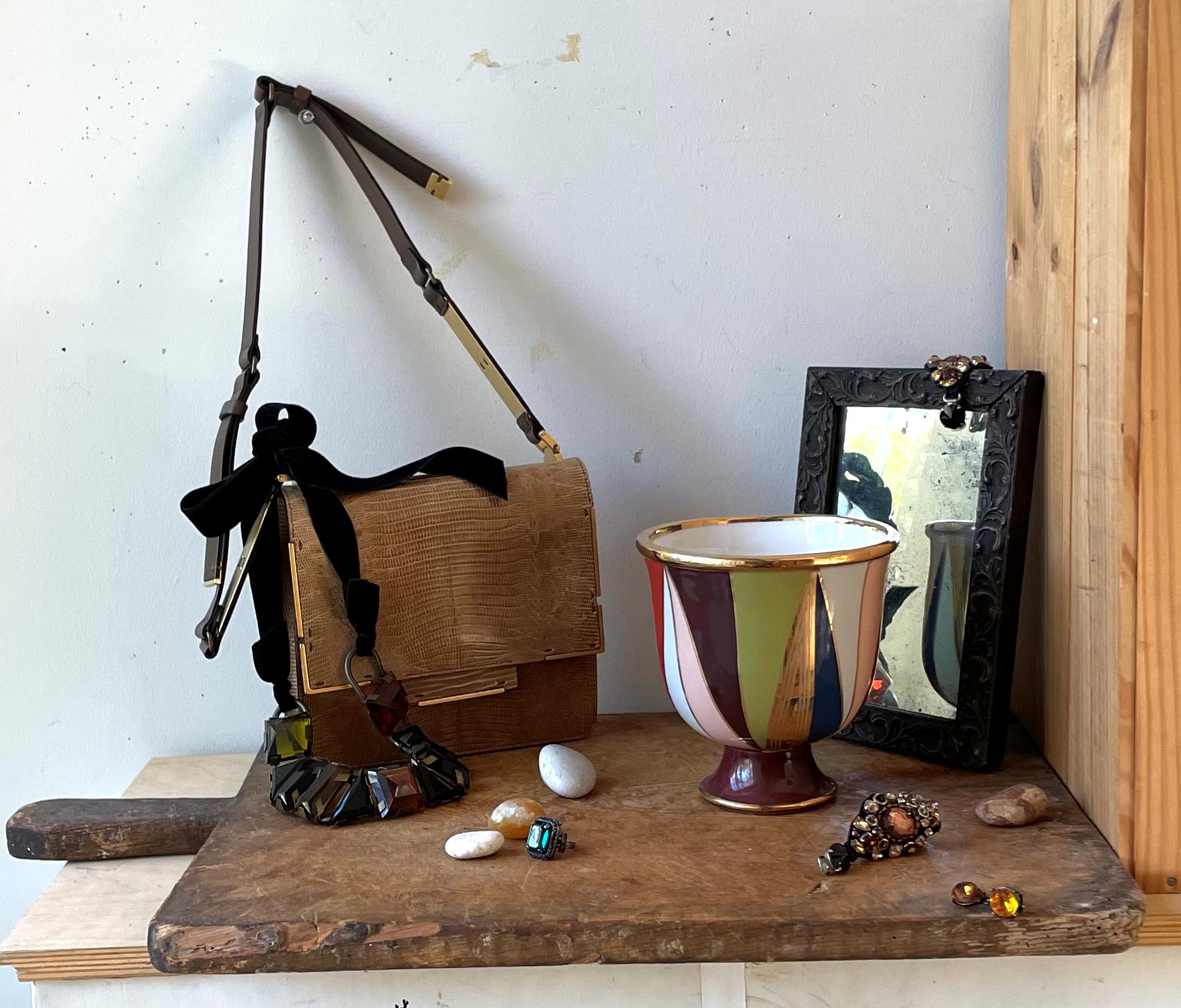
I thought that maybe the black drape looked too heavy, so I took it out and replaced it with an antique cutting board. I also thought that a clear glass vase might lighten things up. I experimented with taking away the necklace. I really liked the complicated shadow cast by the crystal brooch. You can see this change below.
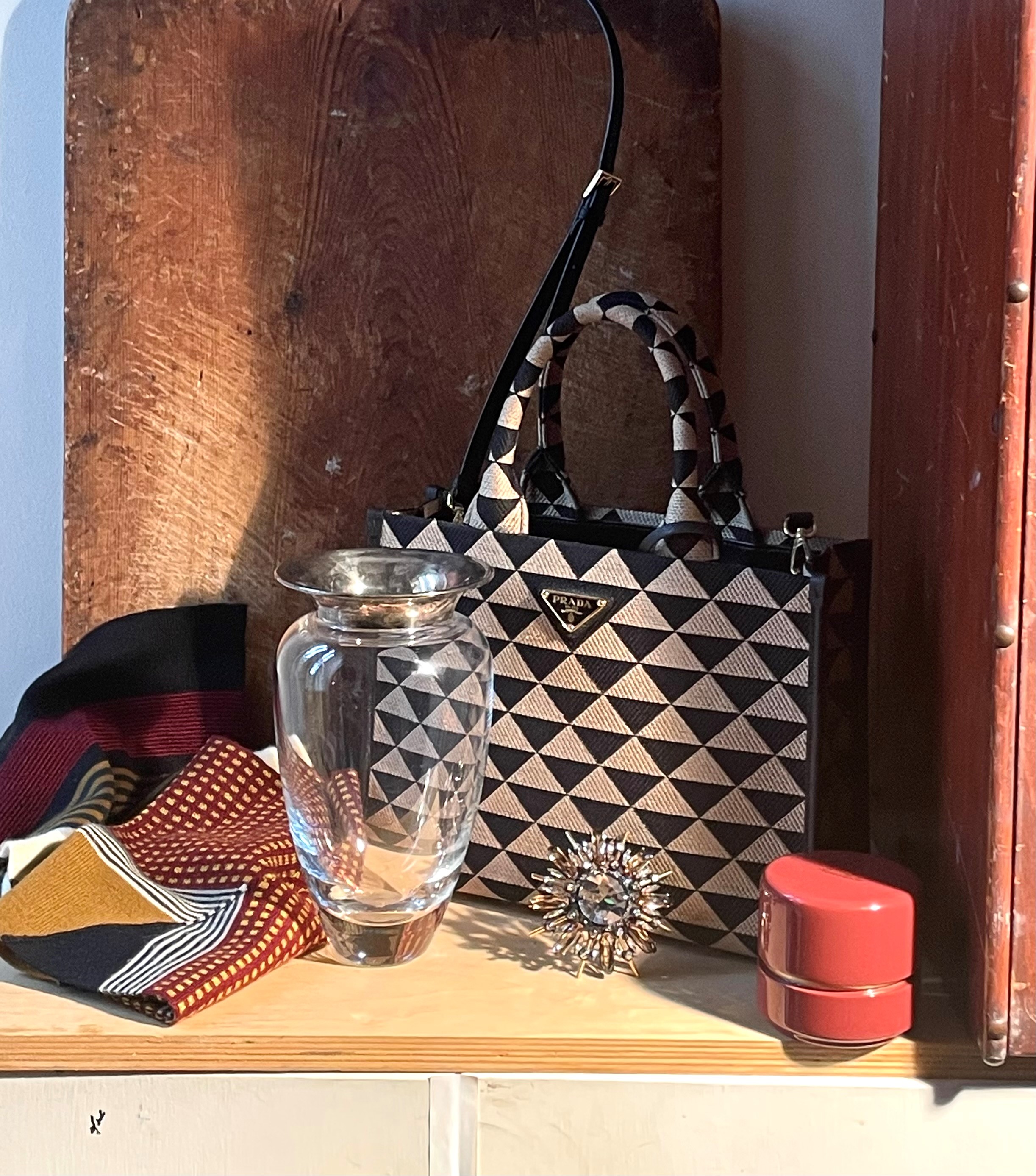
It all seemed a bit crowded. I took out the cutting board and moved the vase and re-arranged the scarf.
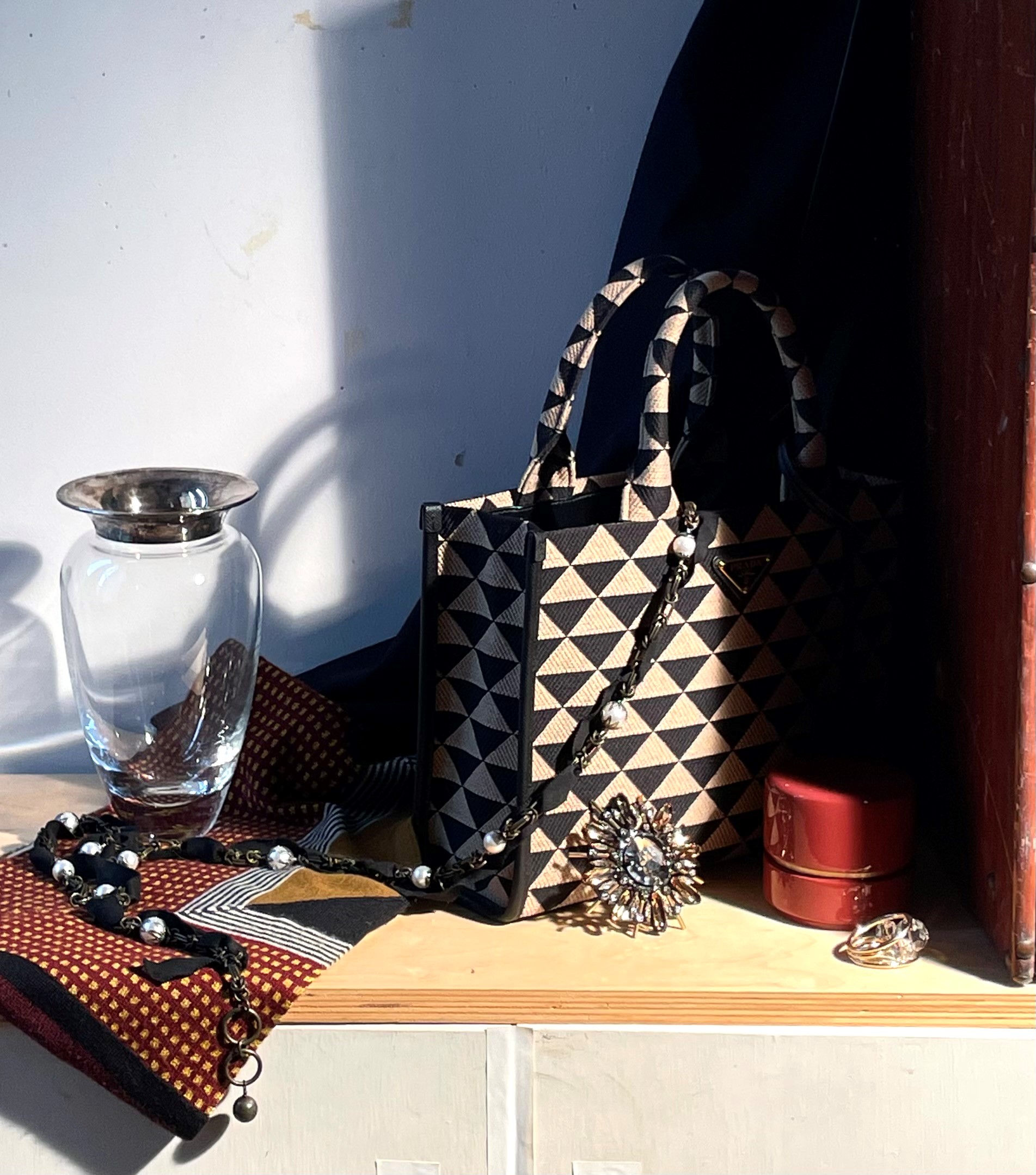
I thought that I liked the set-up with the cutting board more. I put it back, leaving the glass vase over to the left, not in front of the bag, as it was in the last iteration with the board.
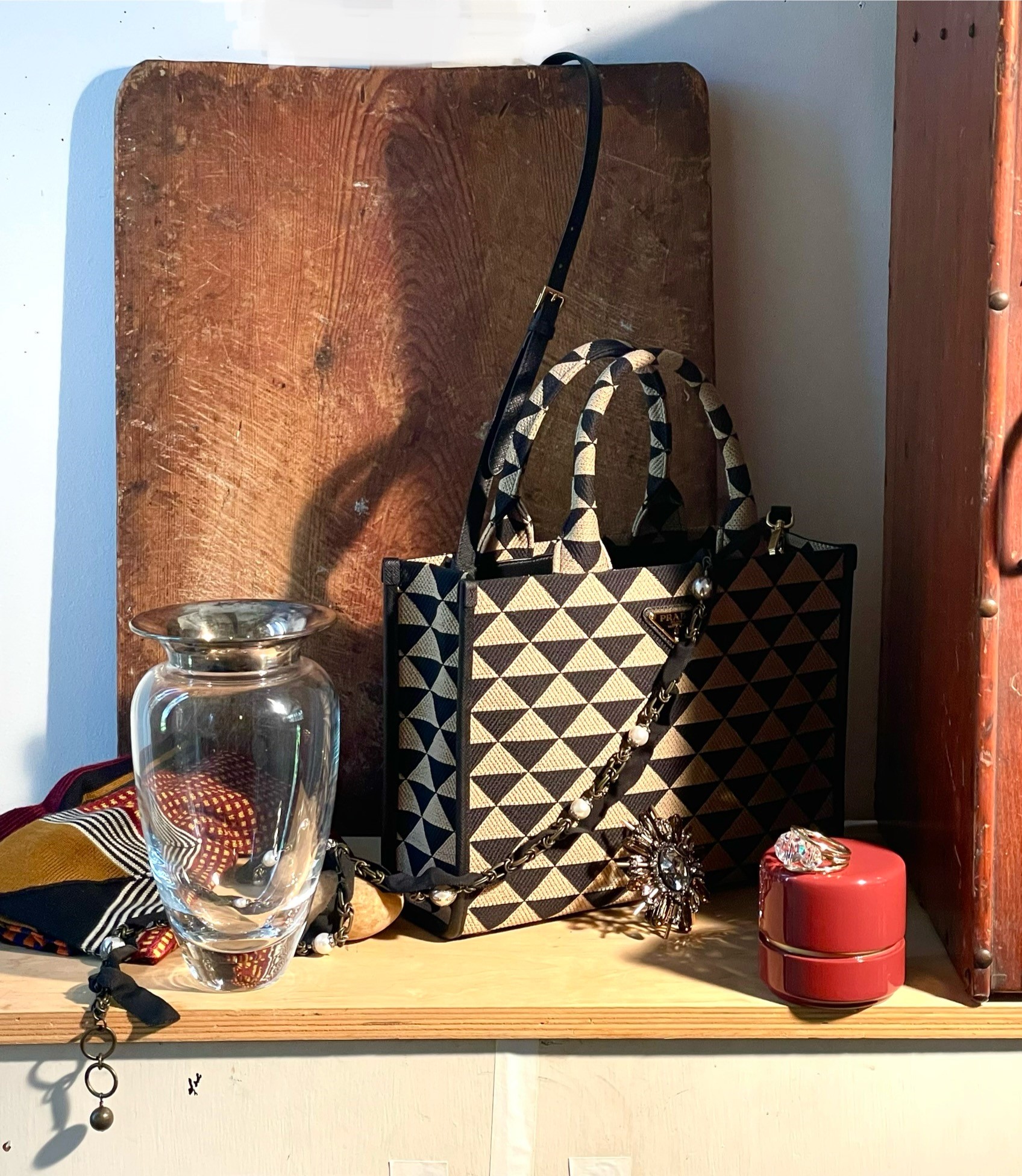
I really like this. I like the cast shadows and the way they echo the sweep of the necklace and strap. I also like the natural light coming in from the window on the left side and all of the reflections cast by the jewelry. I like the way the composition is both dynamic and integrated. I’ll do a drawing next and see if I need to make any adjustments.

Painting the Paper Lamp

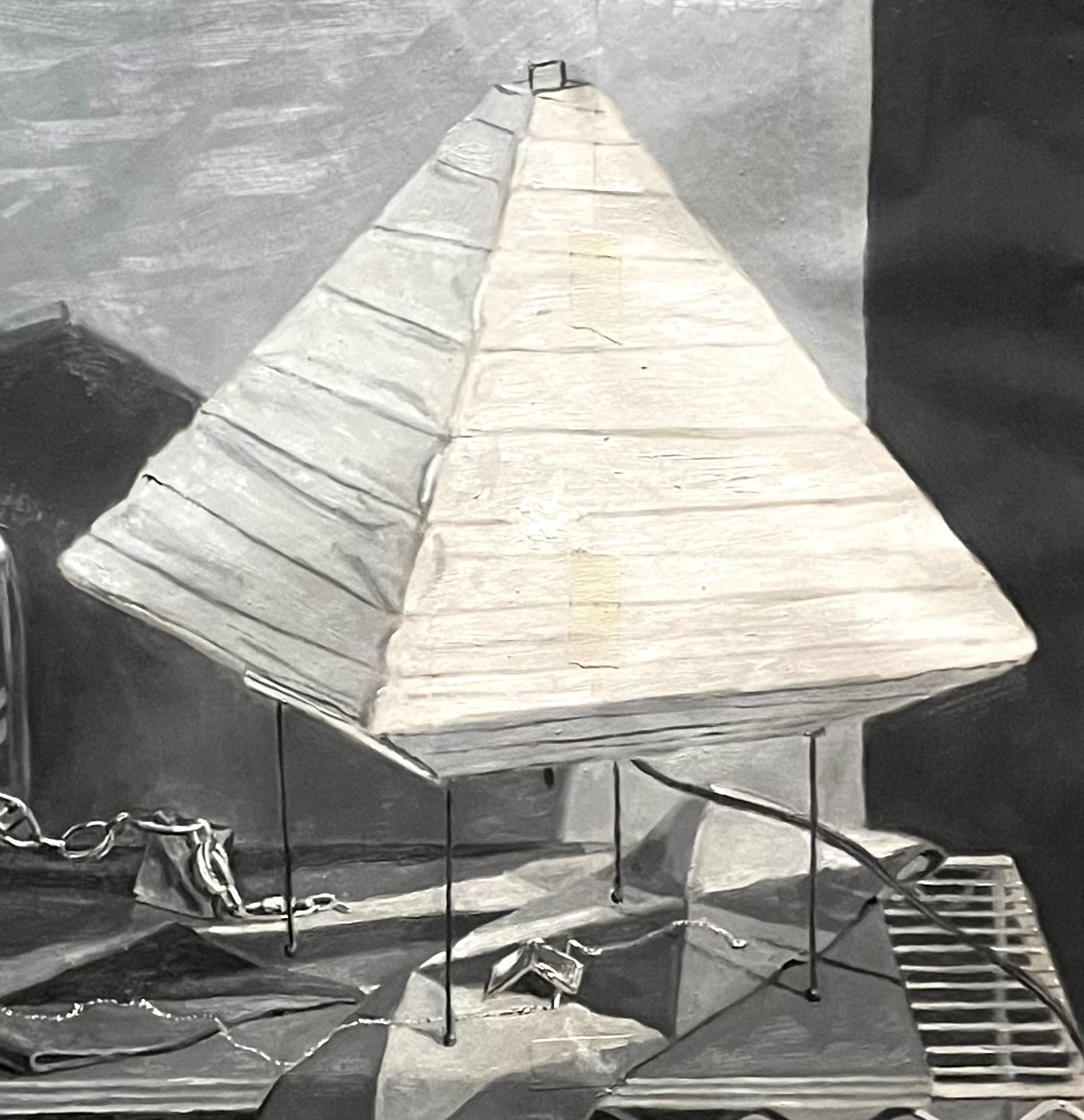
This paper lamp in my latest still life was interesting to paint because it is lit both from the inside and from the outside with my spotlight. As always, I begin with a careful drawing. If you’d like some tips for getting the drawing right, see Drawing My New Set-up.

After I have the drawing mostly correct, I take a break from it and paint a quick study in 9 values of black, white, and gray, on tracing paper. I will use this study to see how my composition looks. It can be easier to judge this in black and white without the distraction of color. I tape the paper right over my drawing, so that I can see through it and use the drawing as a guide. This study is very loose and quick. It usually takes me two days. On the first day, I get all of the shapes and values in. Once that dries, a few days later, I go over it again to correct and adjust. At this point, I study my study to see how the composition looks to me. If I want to make any adjustments to shapes or values, I can make them in the study, and then go back to my drawing and incorporate the changes. You can see the part of my study that includes the lamp, below. I’ll refer back to this study as I paint, using it as a value reference.

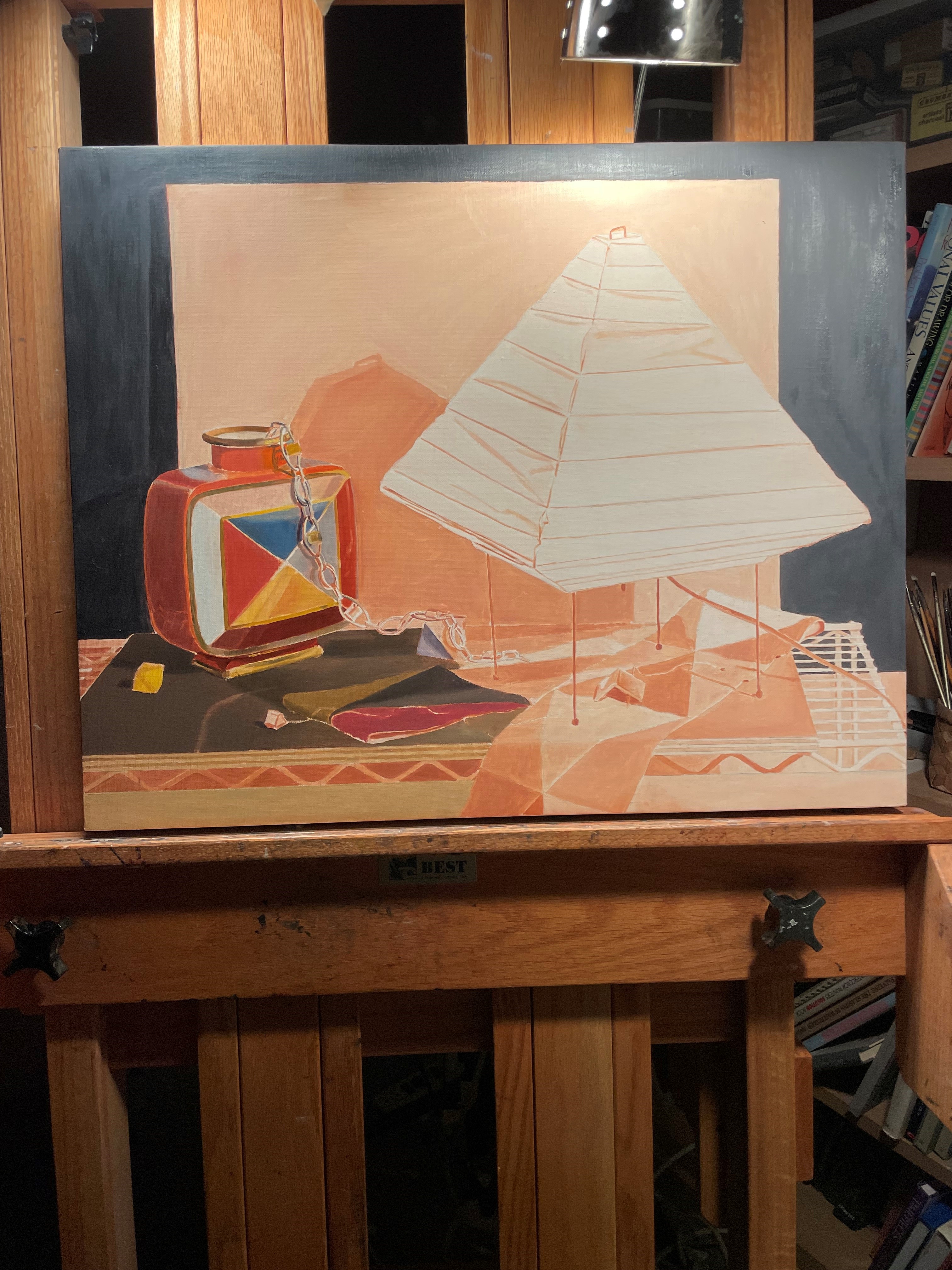
After I am sure about my composition and have transferred the drawing to my canvas (see Transferring the Drawing), I am ready to begin the underpainting. I do this using 9 values of burnt sienna and lead white. I keep it several values lighter than the finished painting will be. The final colors will look brighter against a lighter base. I also paint very thinly and without visible brushstrokes. I keep edges sharp in the underpainting so that I don’t lose the drawing.

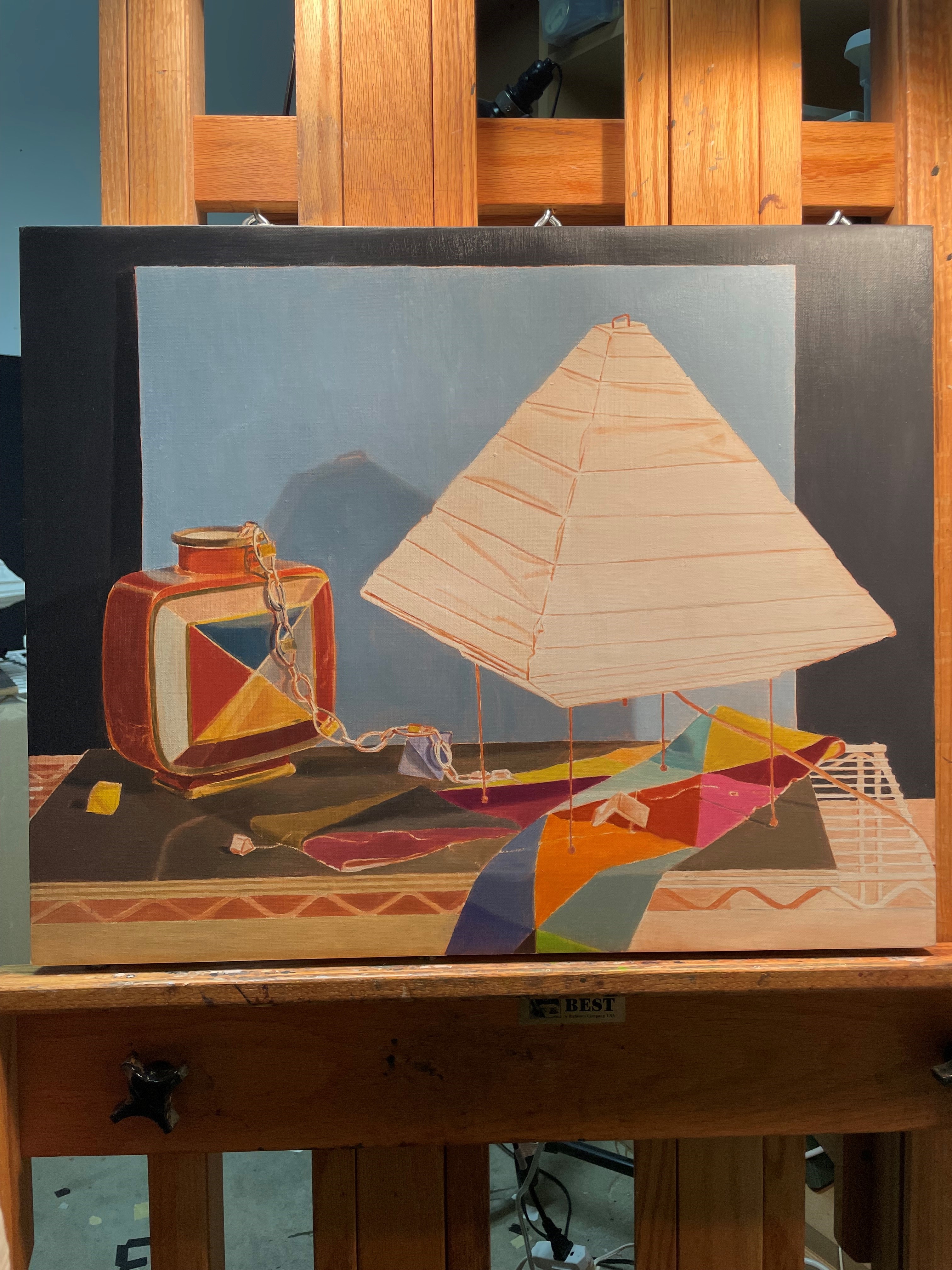
I let the underpainting dry before I begin to paint subsequent layers. Below you can see the first layer of paint. At this stage, i am just trying to put in local colors without trying for too much detail. I have indicated the major creases in the paper, and my first guess at the colors.

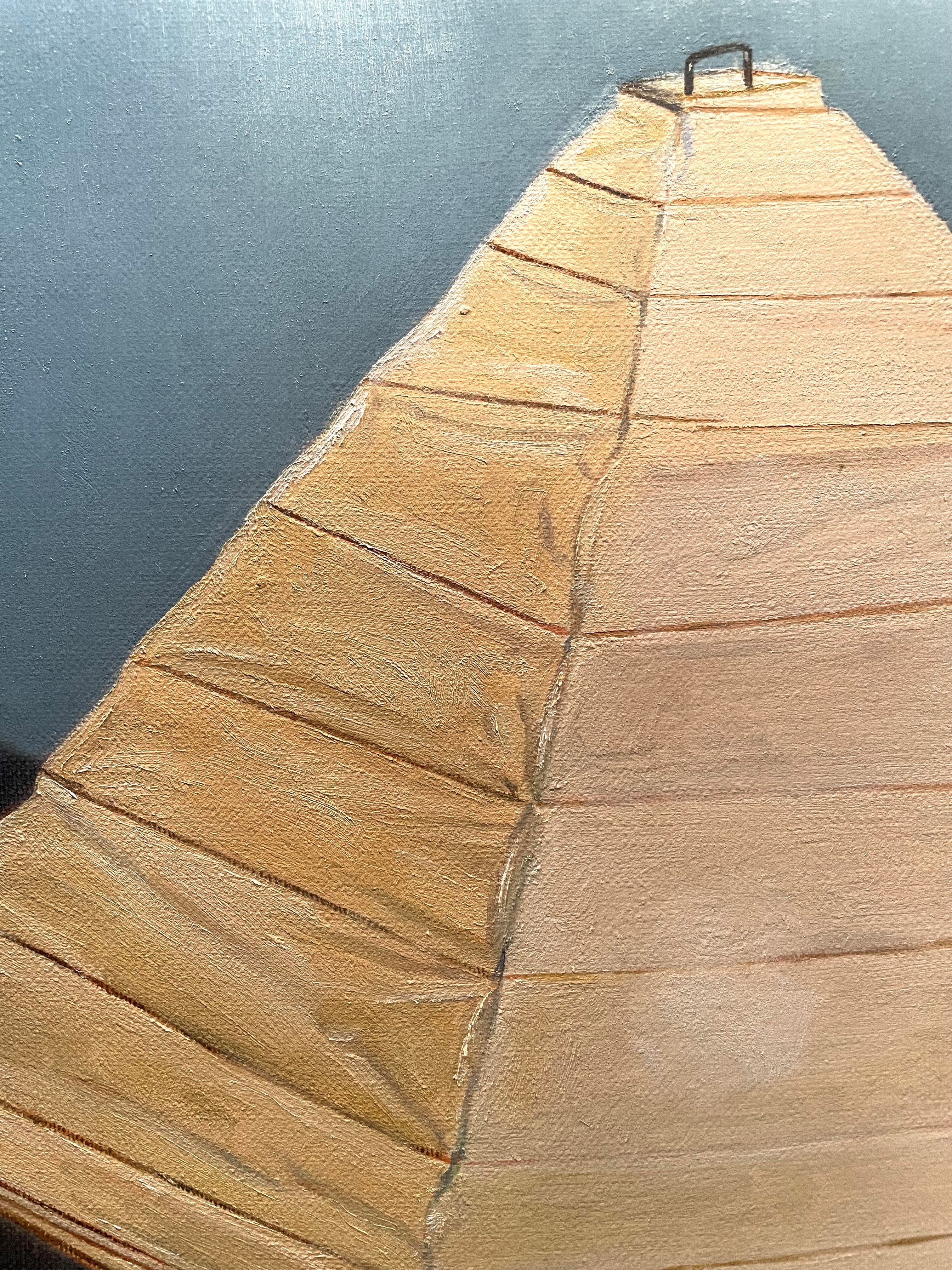
The biggest challenge in painting this lamp, is the very close value range of all of its parts. The left side is the darkest, facing away from my spotlight. I have to save the brightest white for the area directly in front of the bulb, showing on the right side. All other values are keyed from this lightest area, so even though the whole lamp looks bright, everything else must be darker than this small area. This is frustrating because what you end up painting is actually darker than what you’re seeing in reality. It’s important to remember that paint will never be as bright as real light, and we can never have the whole value range of real light available to us in pigments. You have to strive to create the illusion of more light than there actually is.
Above, you can see that the only way to get the spot where the lightbulb shines through is to darken the surrounding areas. I have also begun to indicate the wrinkles and folds in the paper. It’s important to keep these all within a very tight value range. When you stand back and squint your eyes, most of the detail should disappear. Sometimes it’s easiest to begin painting these details a bit darker, so that you can see them clearly. Later, you can go back and lighten them by scumbling a lighter tone over. I’ve also used a mix of warm and cool tones. I find that juxtaposing these can give a shimmer that suggests glowing light.

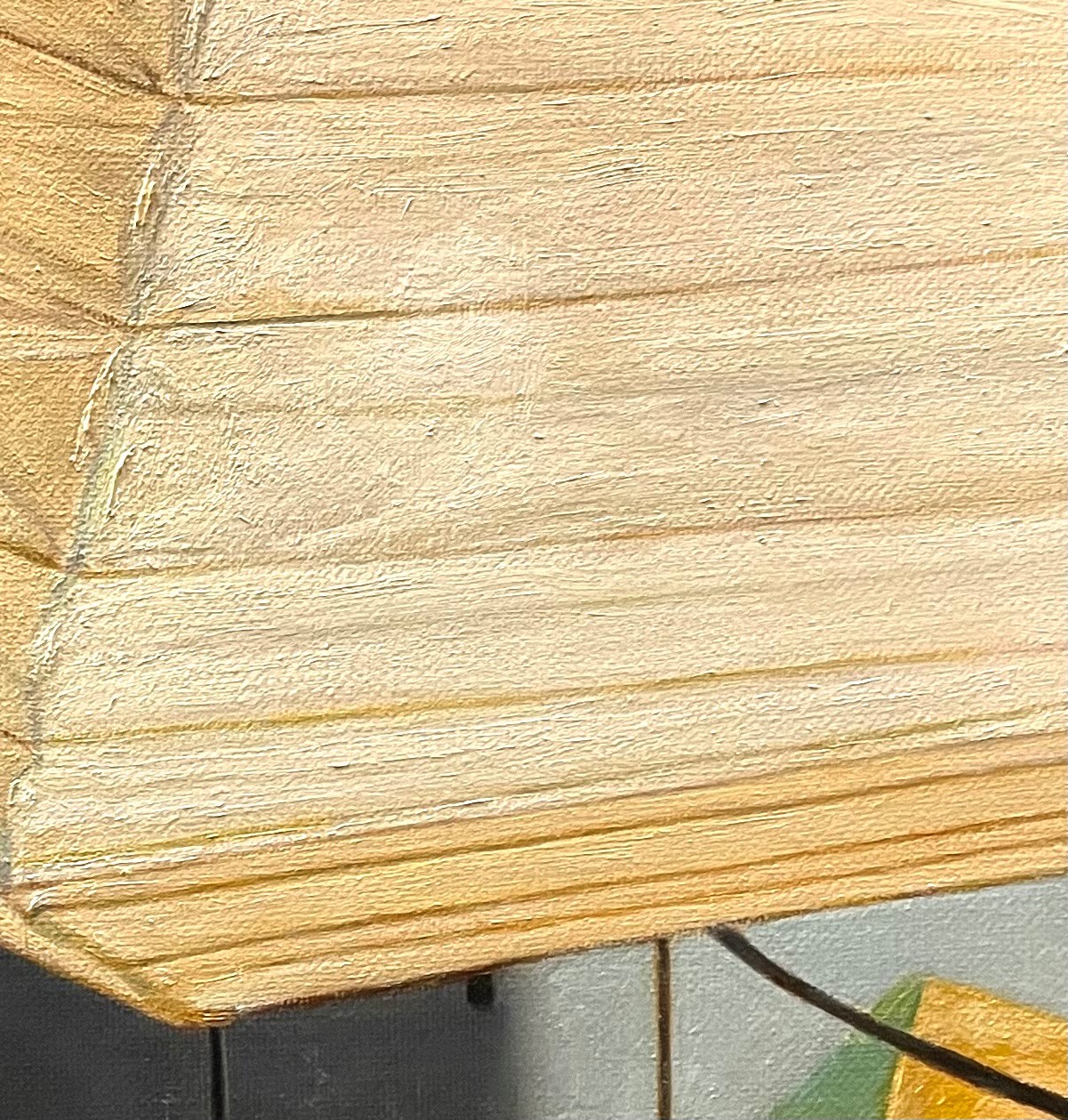
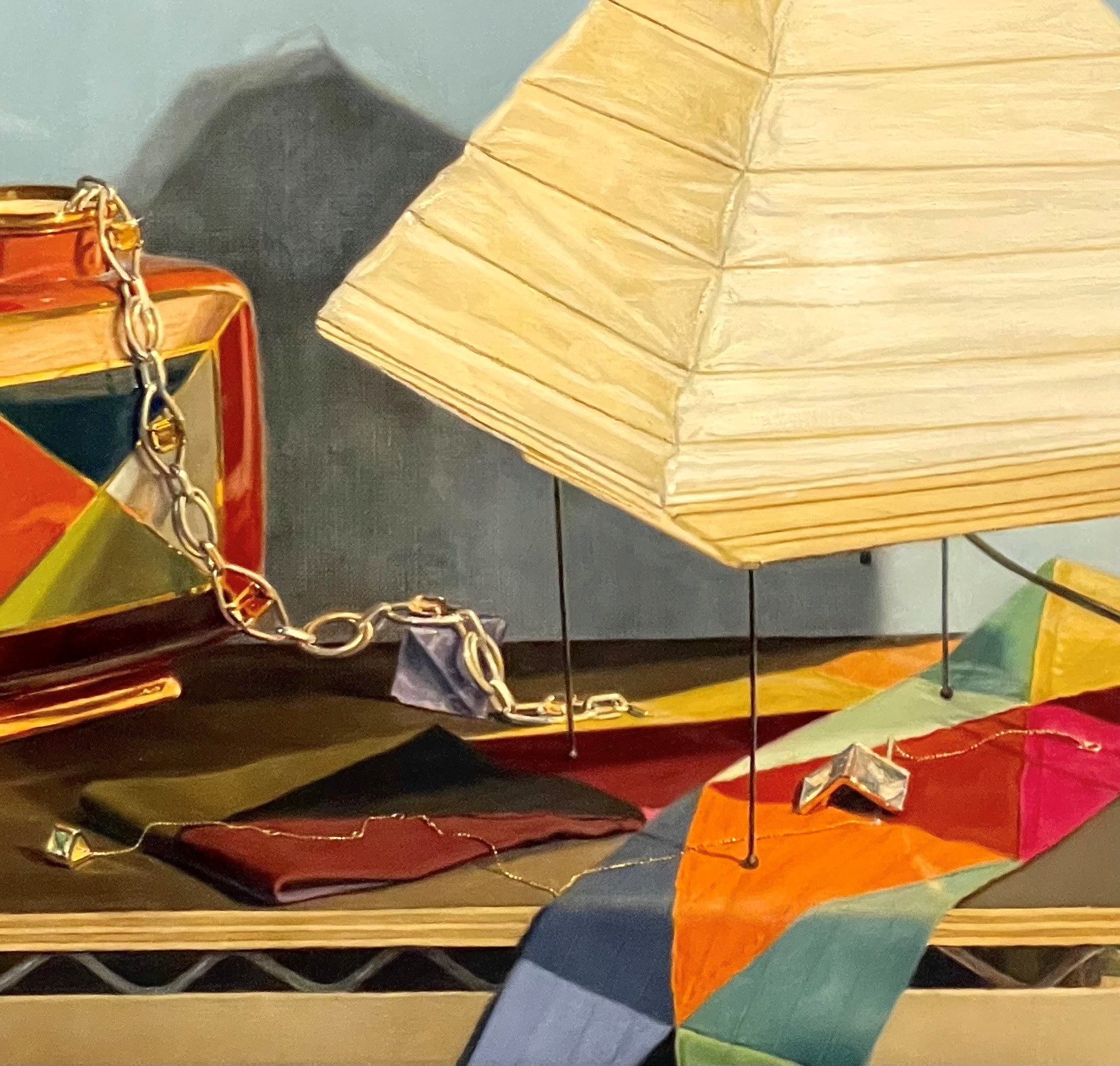
Above is the finished lamp. I tried to keep the edges of the lamp soft, so that it appears to be glowing. Below, there is a close-up where you can all of the subtle value differences, and also the mix of cool and warm tones.

Adjusting the Design at the End

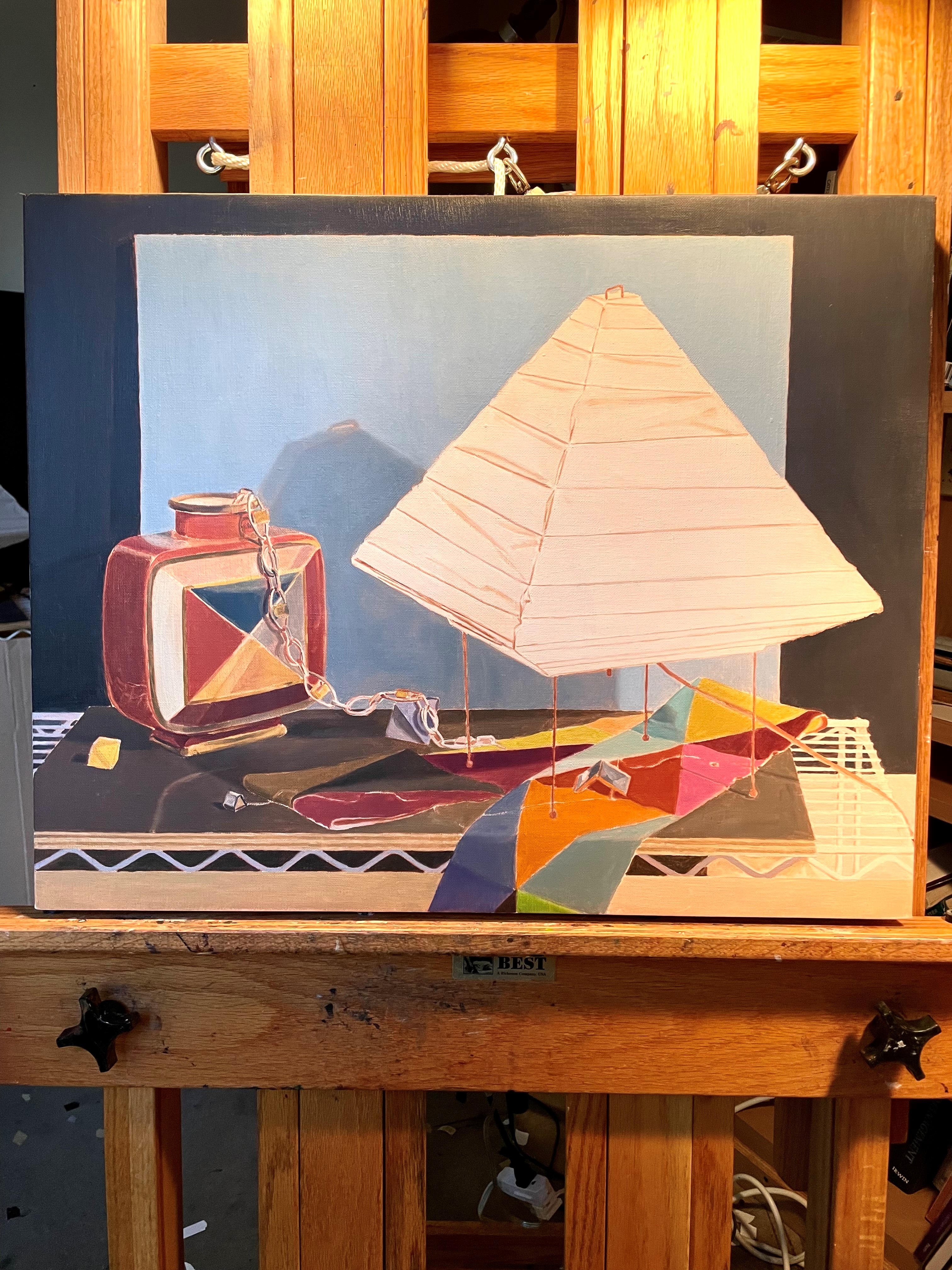
When a painting is almost finished, I like to go back and evaluate if the composition is working. After concentrating for so many months on details, it’s easy to lose sight of the whole composition. One trick I have for doing this is to look at the photo I took of the set-up I chose back in the beginning, when I was setting up the composition. l photograph the set-up options while I am composing a painting, because it is easier to see them as 2-dimensional designs, and I can compare them easily on my phone. I never paint from these photos, however. A photo can never capture the nuances of light and form that you see when looking at reality. Colors appear different, values are simplified, and form can be distorted. For this reason, my painting always ends up not looking exactly like these photos. Usually, that’s not a problem, but sometimes a detail from the photo makes a better design. For instance, in looking back at the original photo, my phone might have exaggerated a color, or made some area brighter. If I decide that it helps the composition, I’ll change the painting. This can be hard to do, after being for so many months in the mode of faithfully representing what’s in front of my eyes, but it’s crucial to remember that it’s the painting that counts. There is no reward given for faithful representation of every aspect of the set-up. Details must always be in the service of a good composition. So, I make changes to improve the composition.

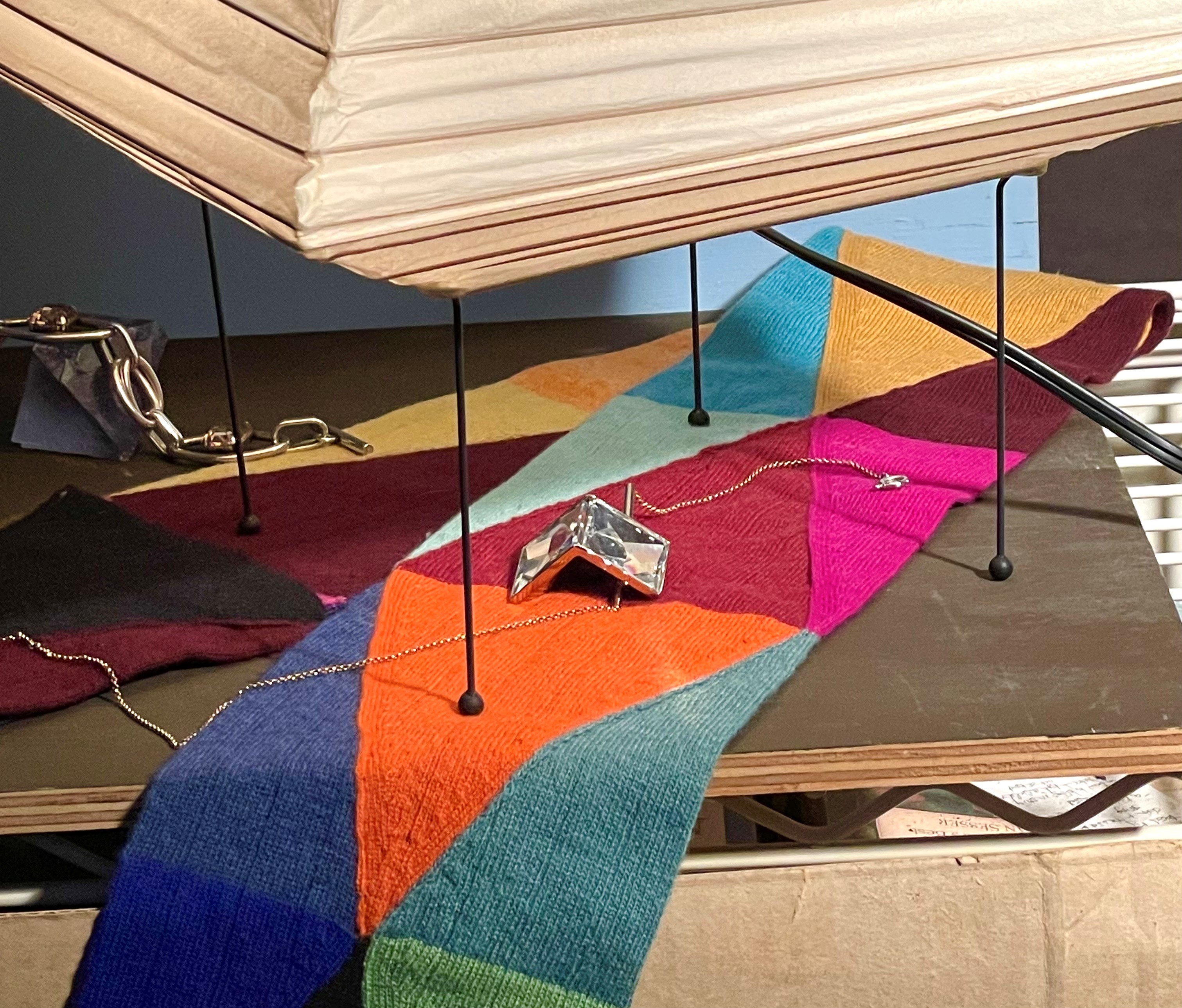
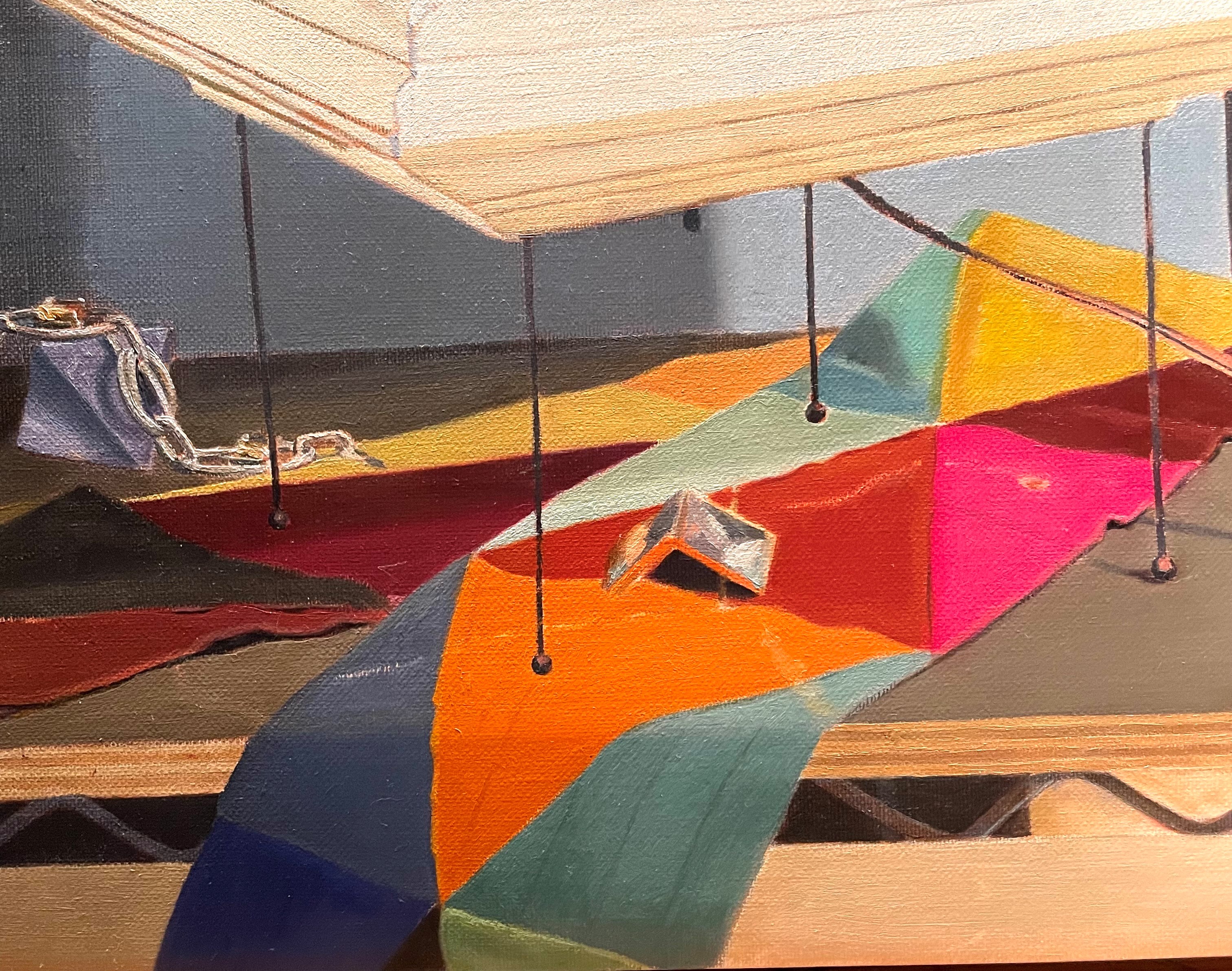
I decided that the left side of the painting was looking a bit dull and flat. In studying the old photo, I saw that the green and red areas in the scarf under the vase were lighter in value than in the actual set-up that I had reproduced. Also, the yellow fluoride crystal was lighter, and the triangular end of the chain necklace had more sparkle. The edge of the pressboard tabletop was lighter, too. I also decided to re-paint the green and orange triangles in the vase a bit brighter, as they appeared in the photo. All of these details seemed to balance the composition, by drawing more attention to the left side. Above, you can see how the painting stood. Below is how it looked after I brightened up these areas.

Though it’s not shown in the picture,above, I shortened the reflection of the vase onto the tabletop so that it doesn’t reach the front edge of the table. I think it was drawing the eye down too much the way it stood.

The dark blue triangle in the scarf at the bottom also has been bothering me. tI seemed to draw the eye down and out of the painting, because of the strong value contrast with the front of the table. I thought I’d experiment with trying it in different colors and values. I cut out some pieces of paper and painted them in different colors to experiment, and lightly taped them onto the canvas to judge them. I painted one in rust, one in green and another in pale blue. The pale blue won! It echoed the blue of the wall, balancing the composition. It was close in value to the front vertical at the bottom of the painting, so it didn’t attract too much attention away from the focal points.

Above you can see the triangle re-painted in light blue. I’ll continue to look at the composition critically in the next few weeks before I declare it finished and sign it.

The Chain Necklace

Chain link jewelry always seems so hard to paint. There are intricate details, yet you don’t want to paint every little thing. The most important way to start is to study the chain to see how it’s constructed. I sometimes take a picture and enlarge it on my phone to study it. It’s best not to paint from the photo, though. Things look a lot different in a photo than in real life. The colors are different, the light is different, and forms can look distorted. Next, I begin to draw! I always do my drawing on paper, not the canvas. It’s much easier. The paper is smoother and more erasable. I’ll transfer the drawing to my canvas later. It’s in the process of drawing that I really get to know my subjects.

Some of the links on the chain were made up of two interlocking oval rings. These were very tricky to draw. I measured as I went to make sure that all of the similar links were the same length. You don’t have to do everything by eye!

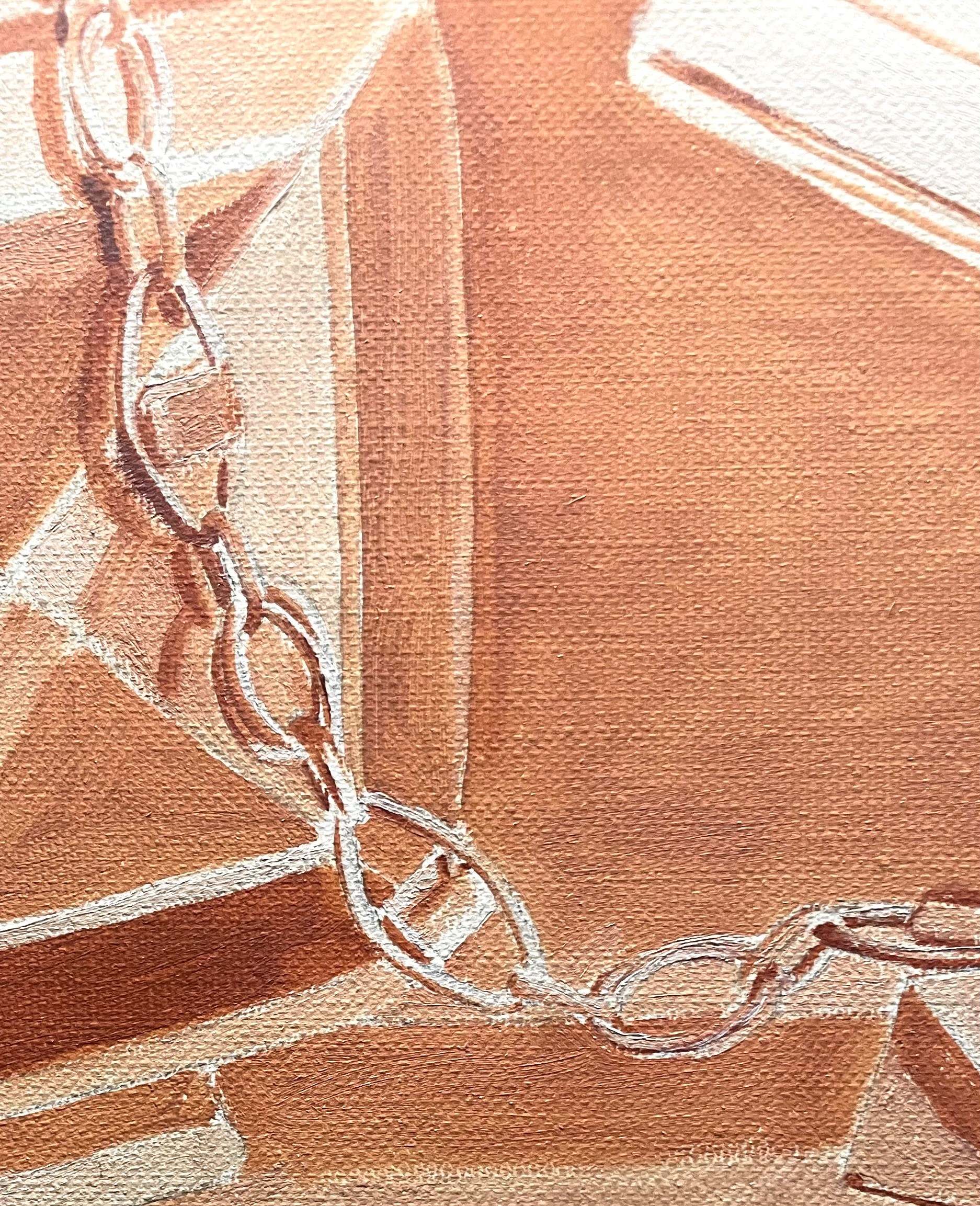
After the drawing was complete, and I transferred it to the canvas, I started the underpainting, above. For more on transferring, see Transferring the Drawing. I do the underpainting in 9 values of burnt sienna and lead white. I keep my edges sharp, so I don’t lose the drawing. I paint thinly, so it will dry quickly. I also use a fan brush to smooth out most brush strokes. I don’t want an unconsidered brushstroke interfering with subsequent layers. Occasionally, I’ll keep a brushstroke visible if I’m sure it will enhance the finished painting. Lastly, everything is painted in a much lighter value than it will be in the finished painting. The colors look more vibrant if the base isn’t too dark.

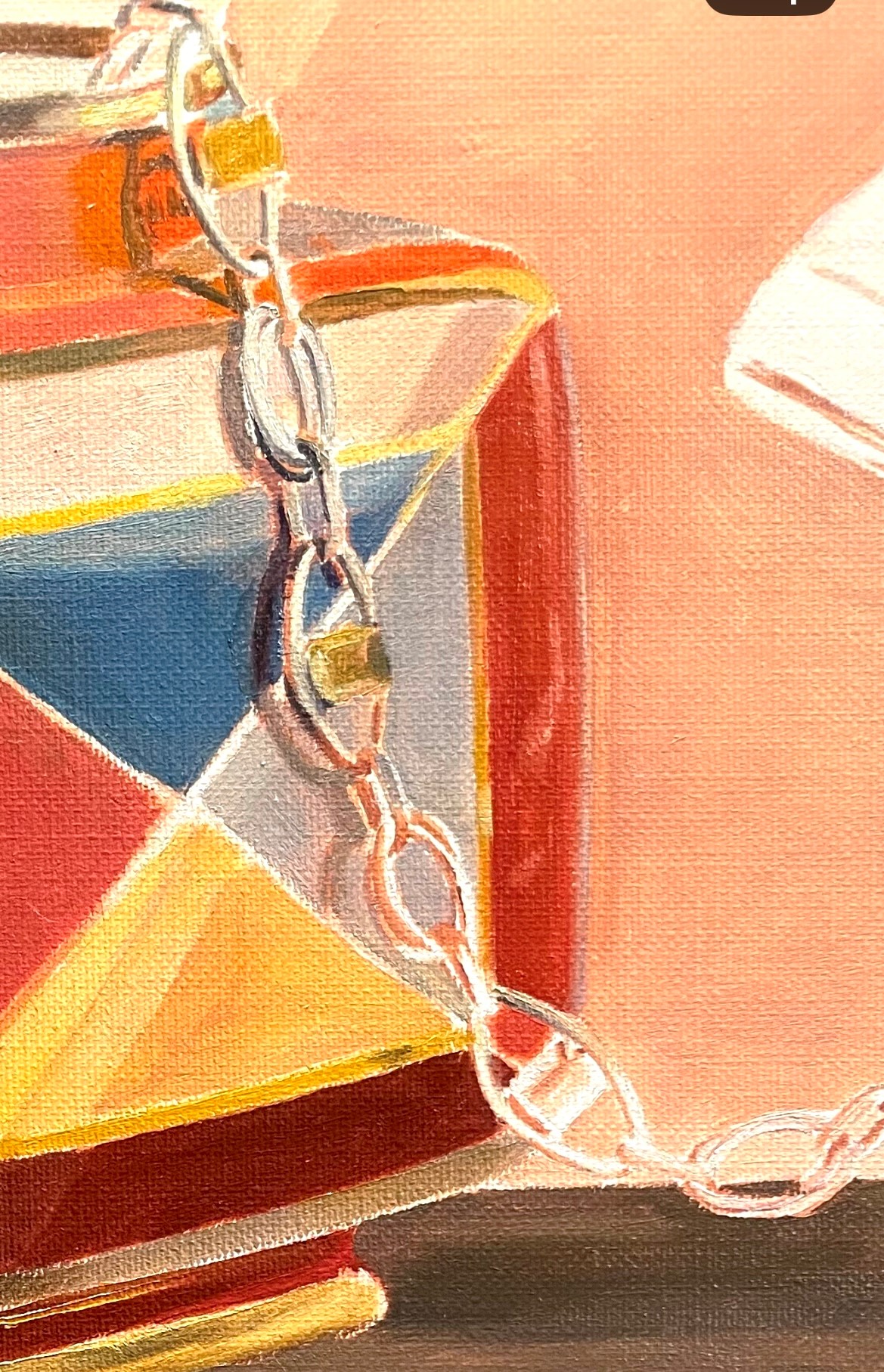
Above is the first layer of color. I’m not too worried about getting it all right at first. It takes many sessions of observing and painting to be able to see what’s going on and figure out the values, colors, and shapes. I find that no matter how careful I am about not losing the drawing, I always seem to, and every painting session is an opportunity to correct. You can see above that the shapes of some of the links are asymmetrical.

Above, I’ve refined some more. After each session, I find that I’m able to see and understand more. I could never do this kind of painting all at once. It needs time.

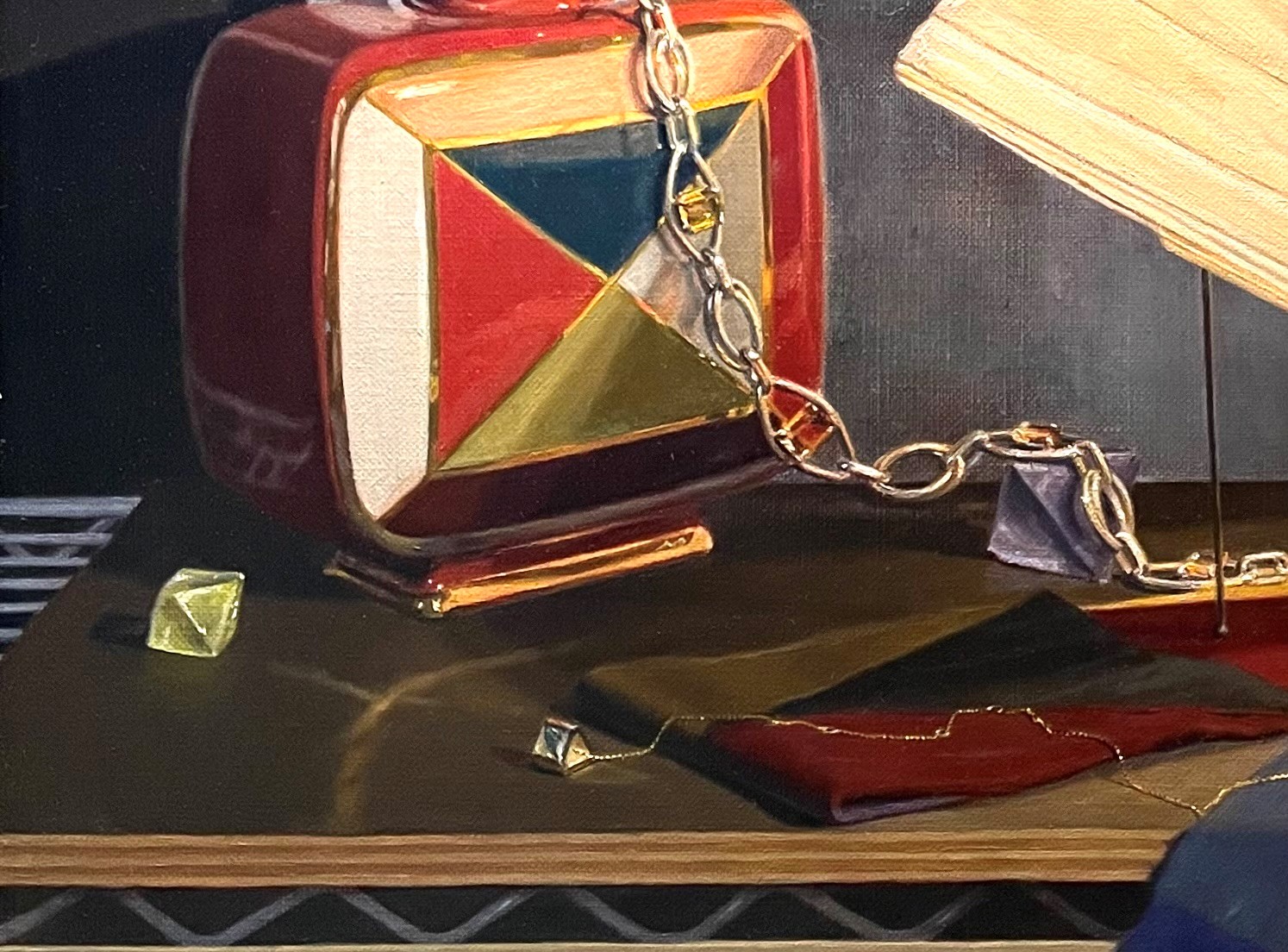
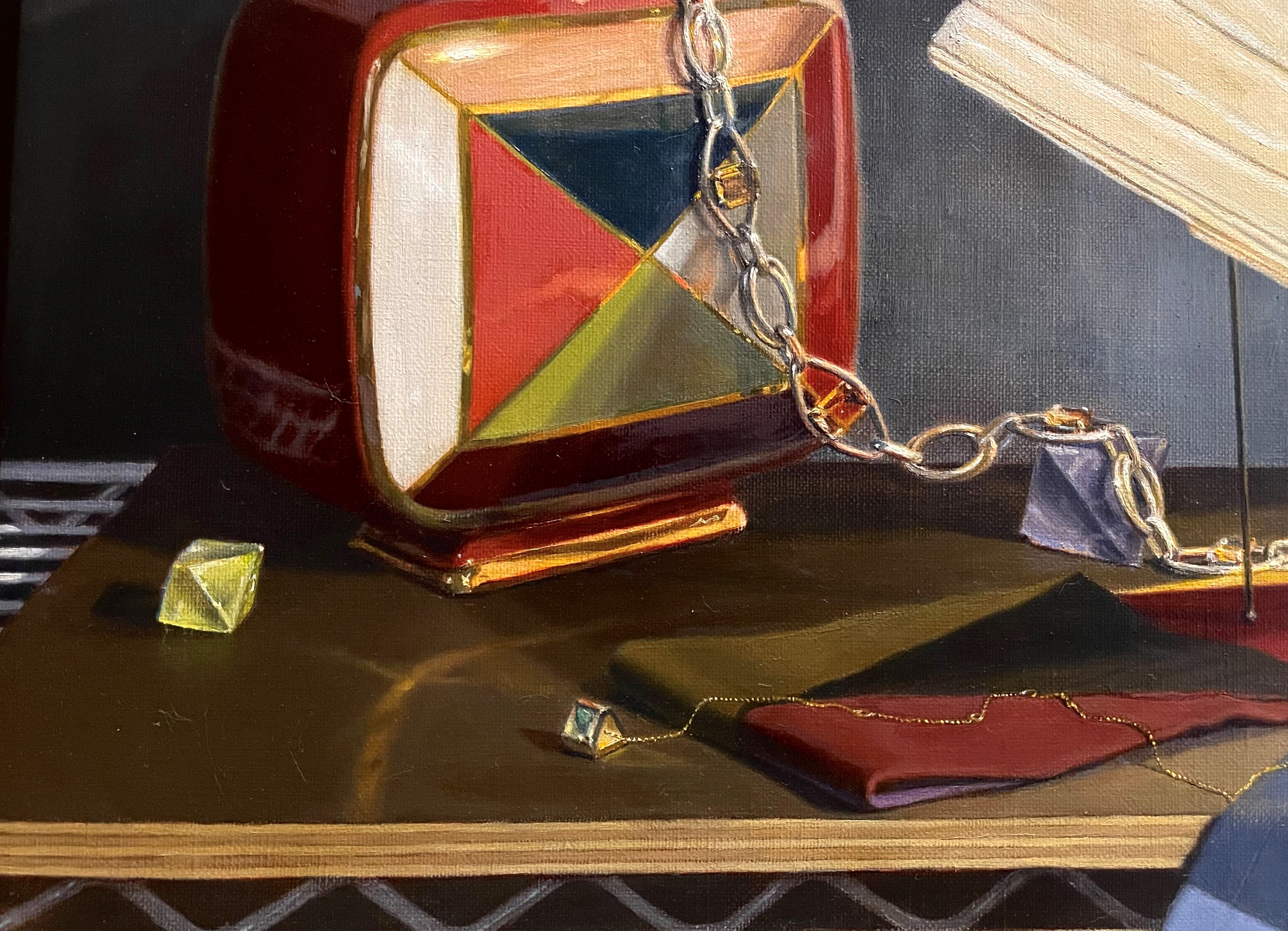
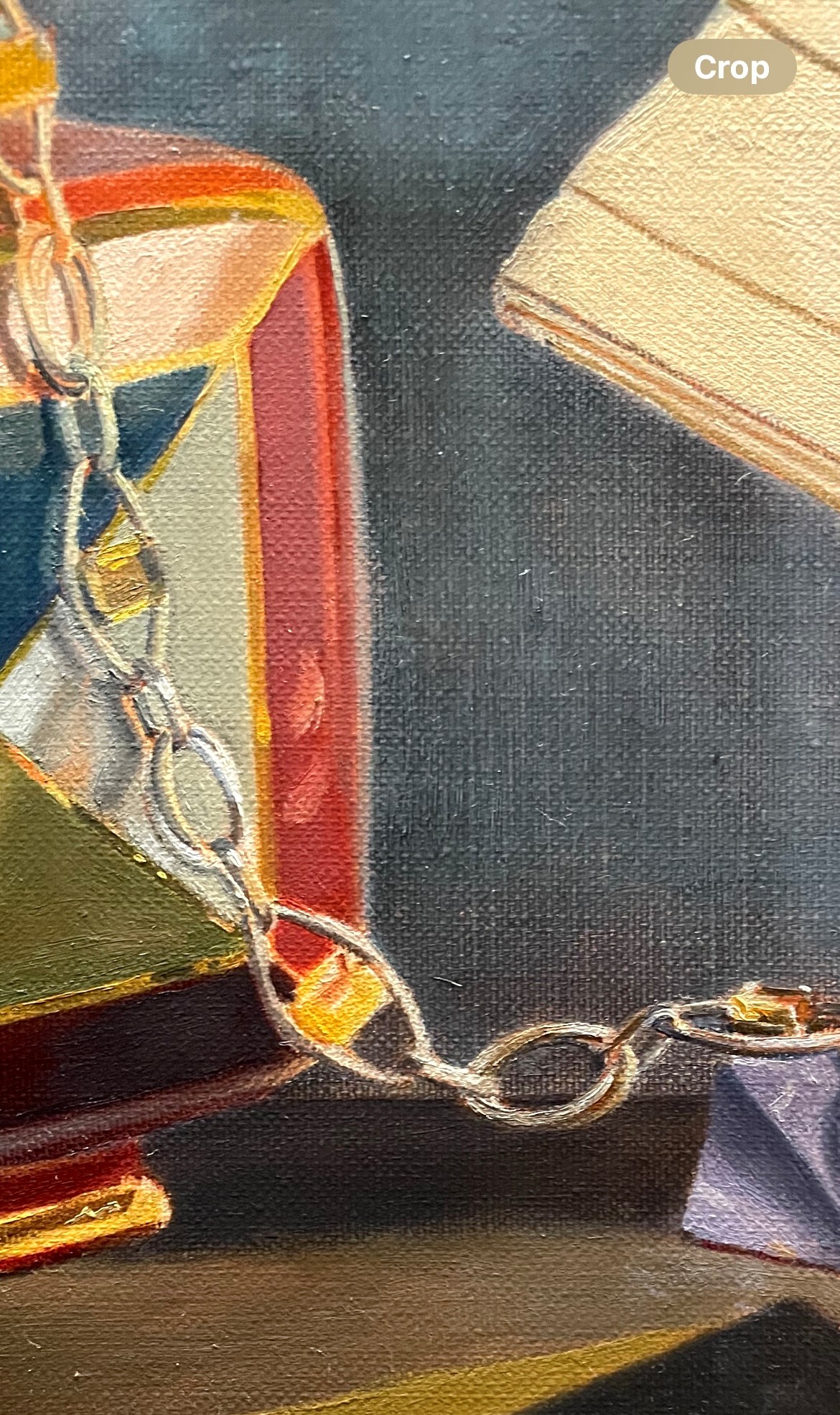
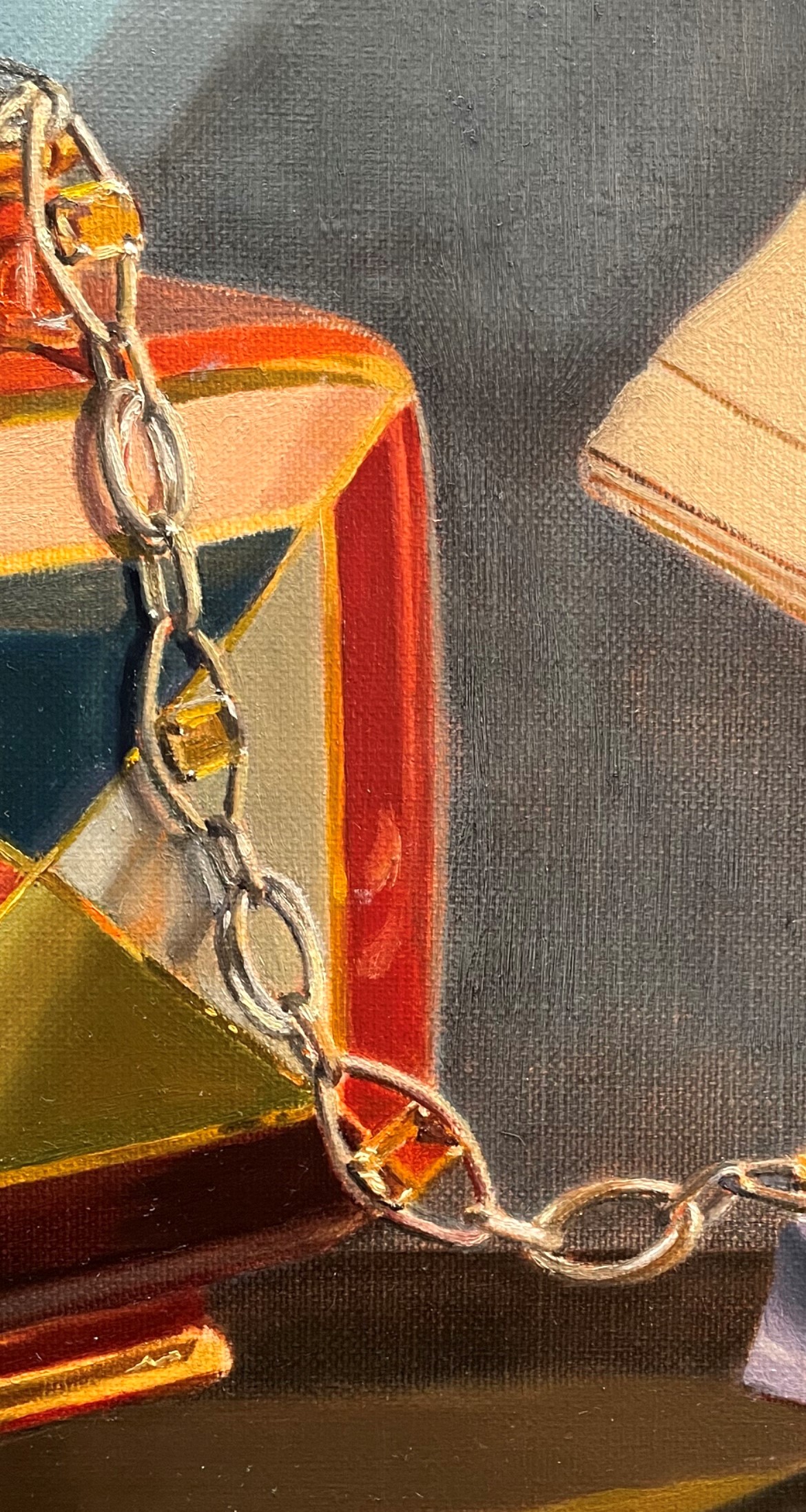
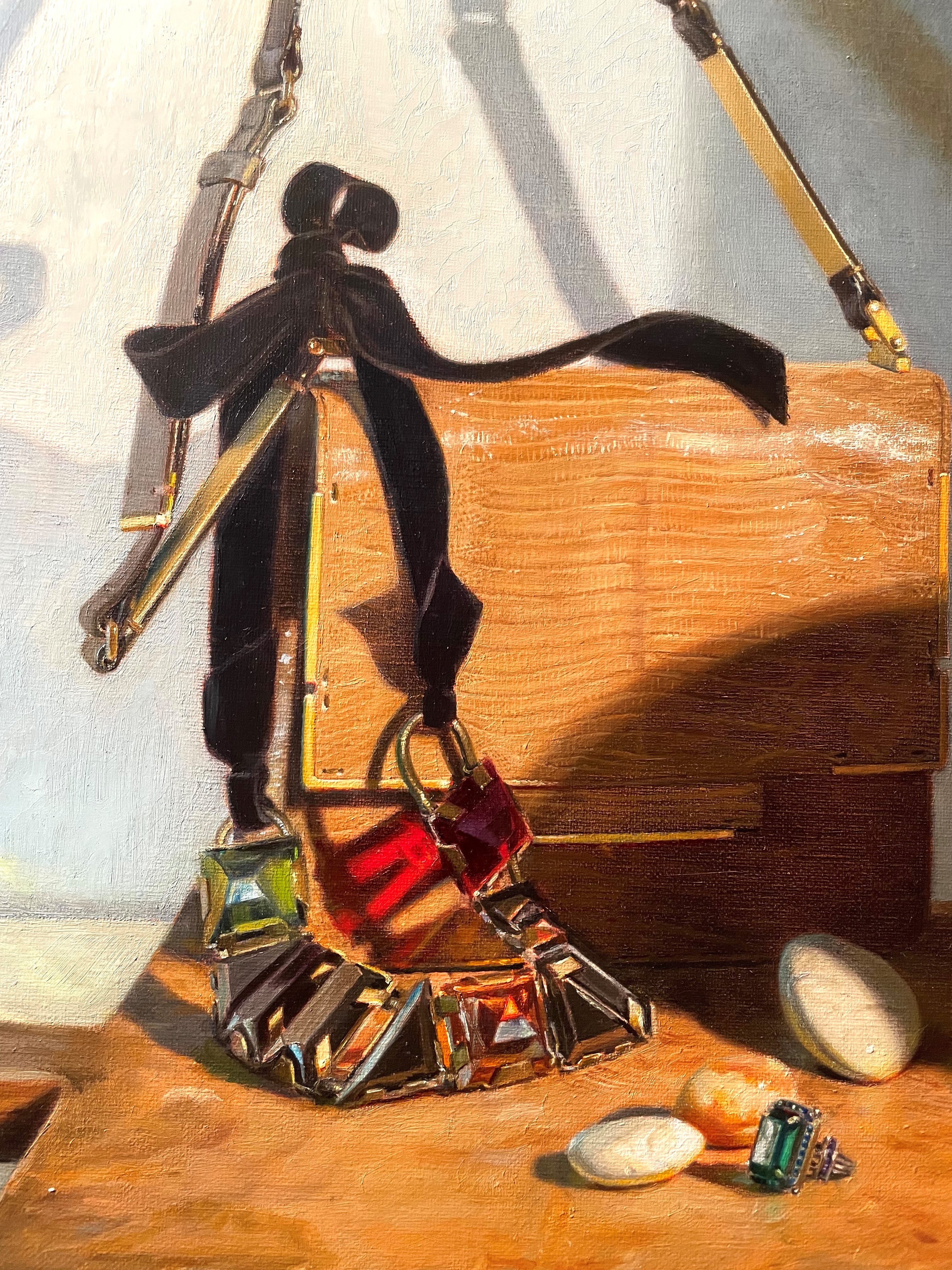
Above is how it stands now. I softened some edges and added highlights and shadows. I corrected and defined the complex curves of the links. I put more detail on the yellow crystals. I worked some more on the cast shadows and reflections onto the vase from the chain. I’d say that it’s almost finished!

Mixing the Right Colors

I need to mix a lot of colors to paint this scarf. Of course, it’s not crucial that I get them exactly as they are in the real scarf for the painting to work, but I do like these colors and composed the painting with them in mind. Below is a picture of the set-up so you can see the colors within the limits of photography. (One reason I never paint from photos is that the colors are never right! I show you this just so you can get a rough idea.)

Below is my first attempt to block in the basic local colors. I’m not trying to capture any nuance yet of shade or reflection. That will come later. Let’s look at a few of the colors I had to mix. The dark orangey-red triangle, right under the lamp, was tricky. I started with an Indian red- a very strongly pigmented earth pigment. It was too dark right out of the tube, so I needed to lighten it. Rather than mix in white, which would have the effect of dulling the color, I added Naples yellow dark. Even this turned a bit chalky because of its light value, so I added cadmium orange-a warm color closer to the value of the Indian red. This looked better but seemed like it needed to be brighter. I added permanent light red. This did the trick. (This illustrates an important fact about lightening red tones. It almost always looks better to lighten them with orange or yellow, not white. White will make the color chalky and dull). Getting the right color often takes some experimenting. I put down a color and see that it is wrong, then I add and test, and try again until it looks good. Sometimes I guess right the first time, but usually it takes me a few tries. Also, keep in mind that colors will look different after they are all painted and you can see them adjacent to each other.

I continued until I had a first guess at all of the colors in the scarf. I let this layer dry, then took another stab at it at my next session. Below, you can see that I’ve adjusted the colors. The rust-colored triangle that I was talking about above seemed too dark. I added even more permanent light red to the Indian red. The hot pink triangle was too pale. Rather than mixing alizarin and white, I decided to glaze pure alizarin over the first layer. This produced a nice vibrant hue. A glaze can often be brighter than a mixed color! I also needed to re-paint the pale yellow and pale orange bits at the back, as they were too light. Darkening these pale, warm colors is very hard to do without without turning them greenish or reddish. For the yellow, I succeeded by adding some transparent golden ochre to the cadmium yellow and white mix I had used for the first layer. For the orange, I mixed lead white, cadmium orange and just a bit of burnt sienna.

A trick I use to judge if colors I’ve painted are correct is to make a window with the thumbs and first fingers of both hands. I peek through these little windows, framing the bit of color in the set-up with one hand and the corresponding area in the painting. I look quickly back-and-forth between them. Seeing the colors isolated from their surroundings makes it easier to compare reality to the painting. Differences will be obvious.

You can correct colors in several ways. You can re-paint with a solid, covering paint layer, glaze with a transparent dark mixture to warm, darken, or alter the underlying color, or you can scumble a thin layer of a light-valued pigment to cool and lighten what’s underneath. Below, I scumbled the large yellow triangle to indicate some lights.

I’ll continue to work on these colors. Sometimes it takes a few sessions to see them clearly. For instance, now that I look at the picture of the set-up below, I can see that the purple triangle on the left is too dark and dull! Also, the dark orange triangle needs to be a bit cooler and more purple. I’ll fix it next time!

It Takes Many Layers of Paint

I was happy to begin to put some color down after my underpainting dried. I was reminded, though, of how unsatisfactory this first layer of color can be. I tend to paint thinly at this point, so the paint film can look insubstantial and streaky. Subsequent layers of paint will go on more solidly and will add nuance. Also, I’m still figuring out which colors and values are correct. Since you have to compare adjoining areas to get this right, it follows that until you get some paint down, you can’t really tell if you’ve got things right. These colors are very much a first guess. For this reason, I don’t try for subtlety or detail at this point. I also don’t bother with edge quality yet. There’s no point in spending effort on effects that will be painted over! Below, you can see this first layer and how sketchy it is.

Below, I’ve worked on the scarf a second time. I adjusted the colors, painted the front edge, and added a shadow on the left side. The paint layer is more substantial now.

Below is the vase after the first layer of color. As with the scarf, the paint layer is thin and streaky, and the values and hues are approximate. The yellow fluorite crystal has only its yellow glaze.

Below, I have completed the second layer of color. I have corrected values and hues, applying the paint more generously. I’ve paid more attention to details and have ‘re-drawn’ some areas around the rim and base. I glazed the left side darker and painted the reflection of the wire table into the wet glaze. I painted some more detail on the crystal. I take every session of painting as an opportunity to see things afresh and correct where needed. The process seems to be never-ending!

I’ll continue this process over the whole painting. As I proceed, I can compare areas to better judge value and color. For instance, once the blue shadow on the right side of the vase is closer to the correct value, I can then get the right side of the vase correct. Painting is a long process of building and correcting.

I Begin Painting

My underpainting is completed and dry, and I’m ready to begin painting! (For more info on underpainting, see Underpainting)

I began with the black background. It’s slightly darker on the left. I mixed three shades of the black, applied them, then blended them together. Getting a smooth transition of tone is one of the hardest things to achieve in paint. I’ll have to tackle the problem again when I paint the light blue board leaning against the wall. I also began putting in the local colors on the vase. I’m not going for subtlety yet- just the basic colors. I can’t judge color and value properly until I have more colors down to compare. Any detail put in now would probably need to be corrected and painted over anyway. I painted what will be the green areas of the vase and crystal with cadmium yellow, in preparation for glazing in green. This will give me a brighter green than I could get with a mixed green.

Below, I’ve continued putting in local colors on the tabletop and scarf. The paint on the background has sunken in. That’s when the oils in a paint mixture are absorbed into the underlayer. This results in a spotty, matt finish. I can correct this later and bring back the shine with a thin layer of my glaze medium.

Below, I’ve tackled the blue background. For this, I mixed 7 values of the blue, so I could get a smooth transition from darkest on the left to lightest on the right. I knew that there was a good chance I’d need to re-paint this, but I took a shot at it anyway. As it turns out, it wasn’t as smooth a transition as I’d like, so I’ll just correct it later! By the way, this took me several hours! Painting really does take time. I painted the shadow cast by the lamp much lighter than it will be because I plan on glazing it later. I like the way that glazing shadows mimics the look of an actual shadow in its transparency and subtlety.

I’ve finished most of the first layer below. I still have to do the paper lampshade. I’ll have to let this layer dry before I can start painting over it with glazes and direct paint.

Here’s a close-up, below. You can see how I’m still avoiding detail and subtle gradations of color. That will happen soon! Slow and steady is the name of the game.

A New Set-up

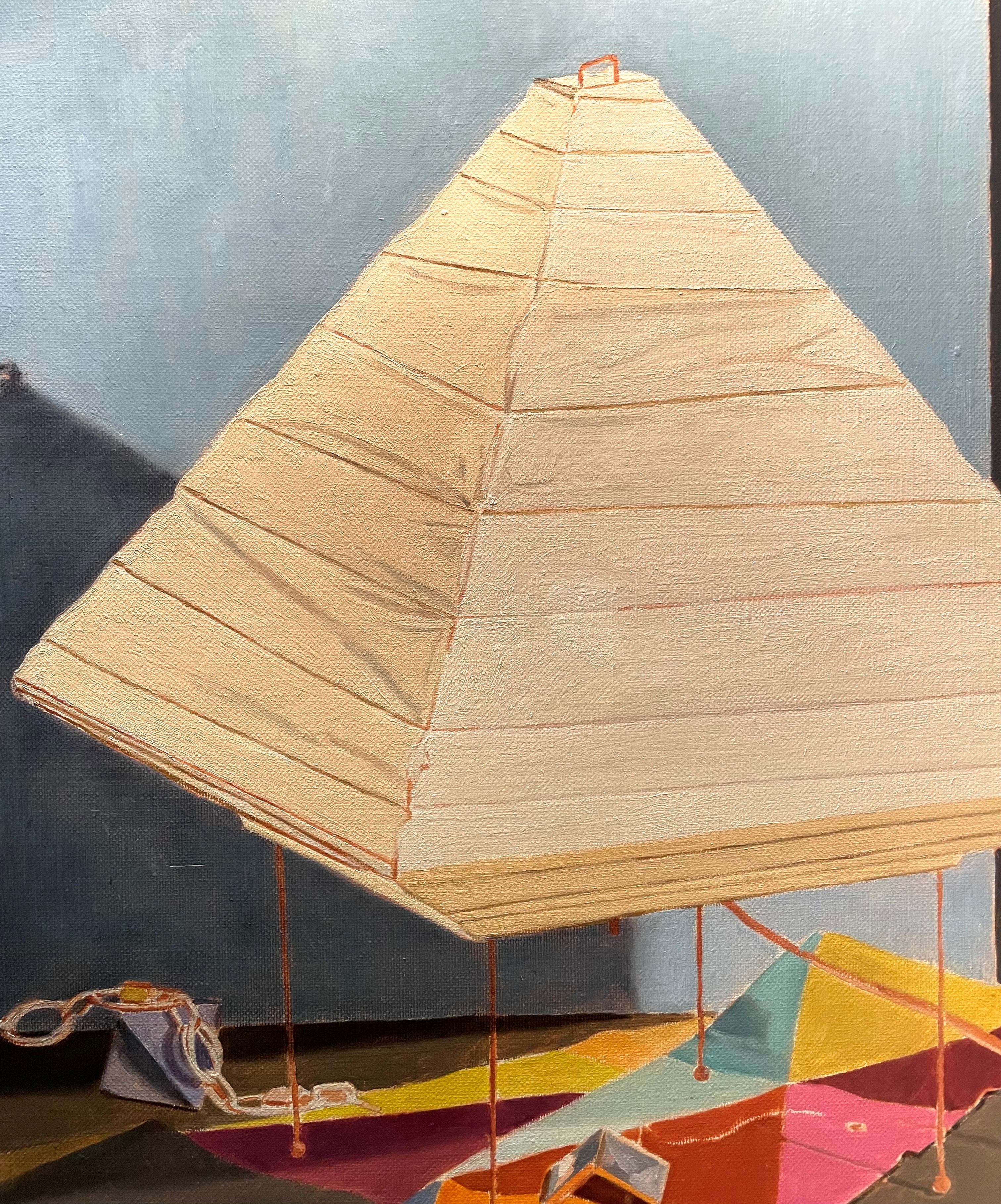
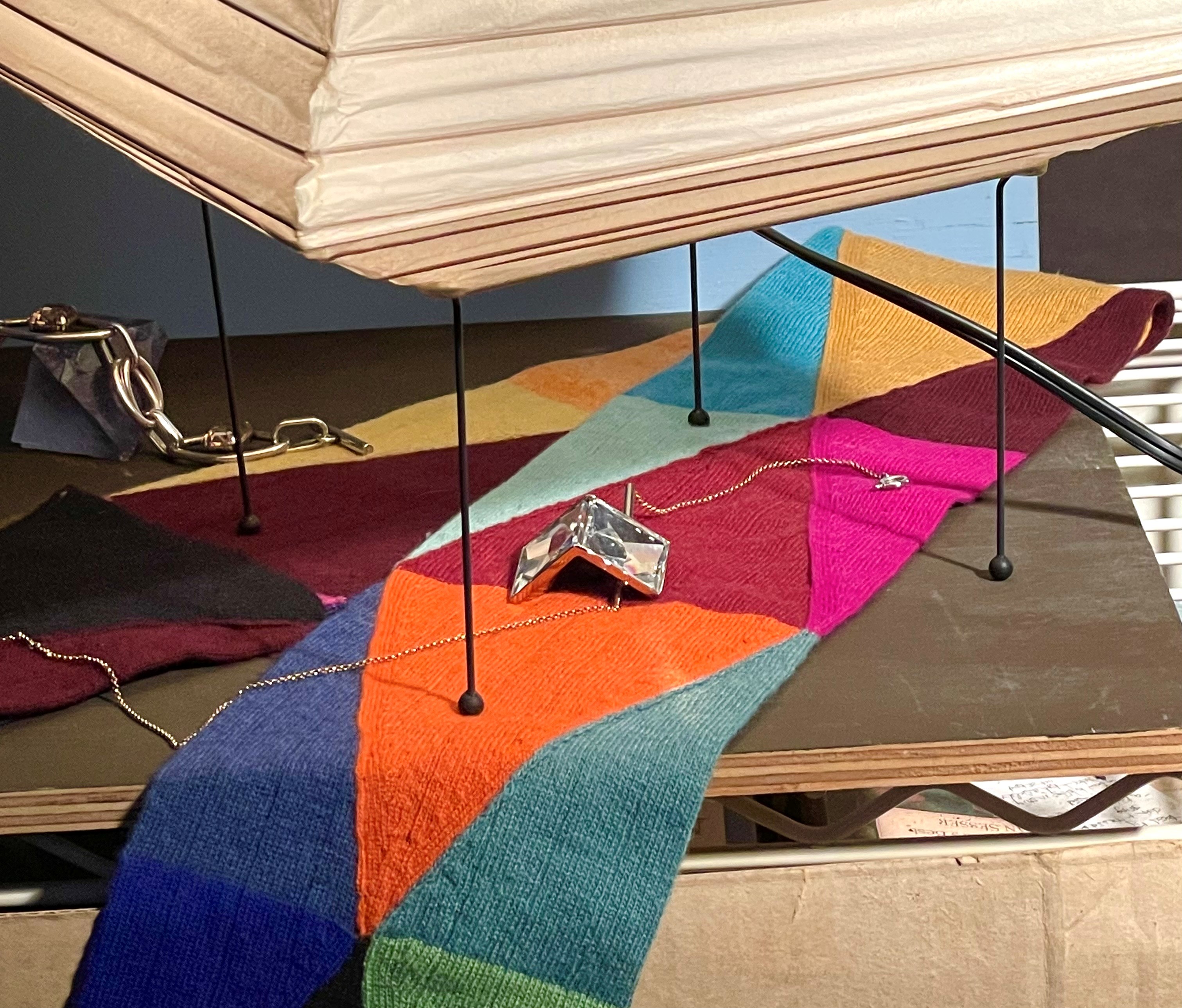
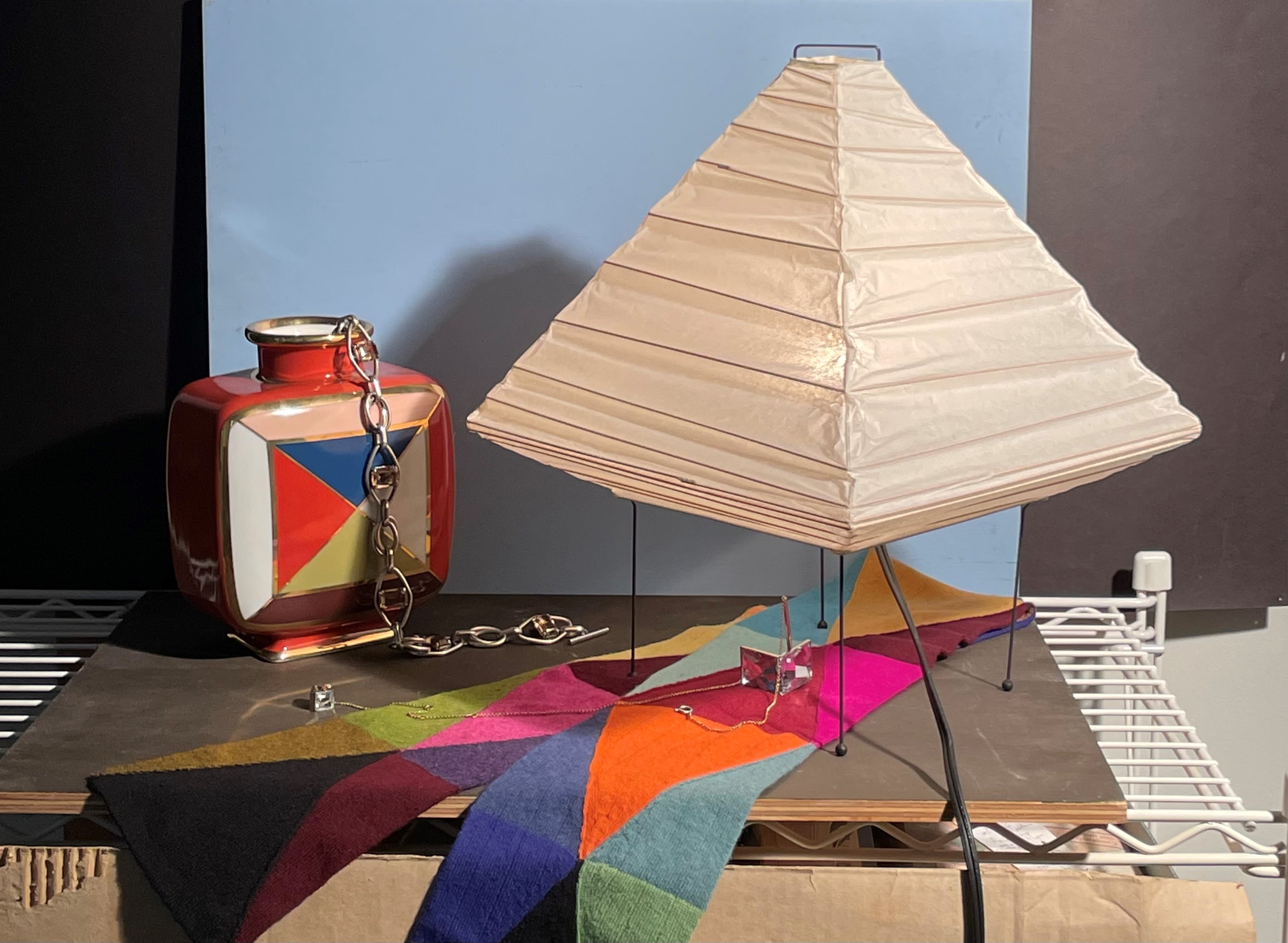
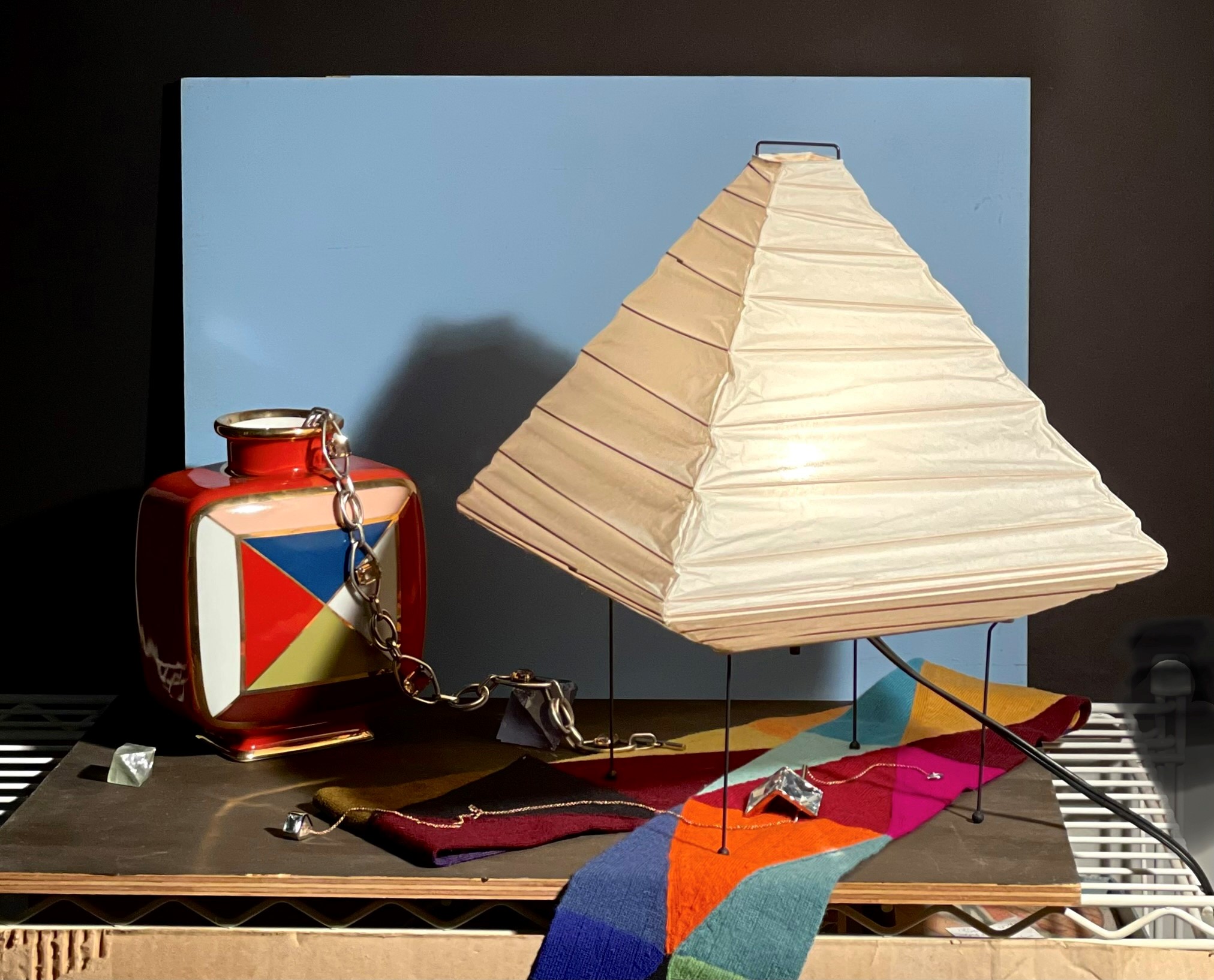
I have three versions of this patterned vase, all different shapes and sizes, two of which I’ve painted before. I loved working with the bright colors, so I thought I’d give this one a go. I’ve also been wanting to paint another Noguchi Lamp. I got this one for myself as a Christmas gift last year. I had an idea that they might work together. I put them on my set-up table and turned on my spotlight on the right. I also turned on the Noguchi lamp. It has a very small lightbulb, but it casts an interesting secondary light. I studied them together and decided that I’d like to add something to tie them together. I looked through my scarves and found this one, which seemed perfect. The colored triangles picked up the colored triangle in the vase. Seeing them all together made me realize that the reason I liked the Noguchi lamp with the vase is that are both composed of triangles. Now I have a triangle theme going on! To add some small detail, I added the two necklaces. I like how I can use the chains to direct the eye. Not coincidentally, they both have triangular elements.
I wasn’t happy with the plain background. Below, I added the blue panel to frame the subject and add some more color to bring out the colors in the vase and scarf. I wanted to bring the color up into the middle right side of the composition, so I re-arranged the scarf

I didn’t like that the large necklace was pointing straight down, so I added the purple crystal and draped the necklace over it. You can see this below. This placement helped to unite the vase and lamp and added an interesting curve. I added the yellow crystal on the left. It provides a pleasing echo of the purple one but is of a different size and color. This gives me repetition and variety- always an effective strategy. I flipped over the other pendent to clarify the shape, and show its triangular shape. Finally, I thought that the scarf might be leading the eye downwards, out of the composition, so I tried folding up one of its bottom edges.

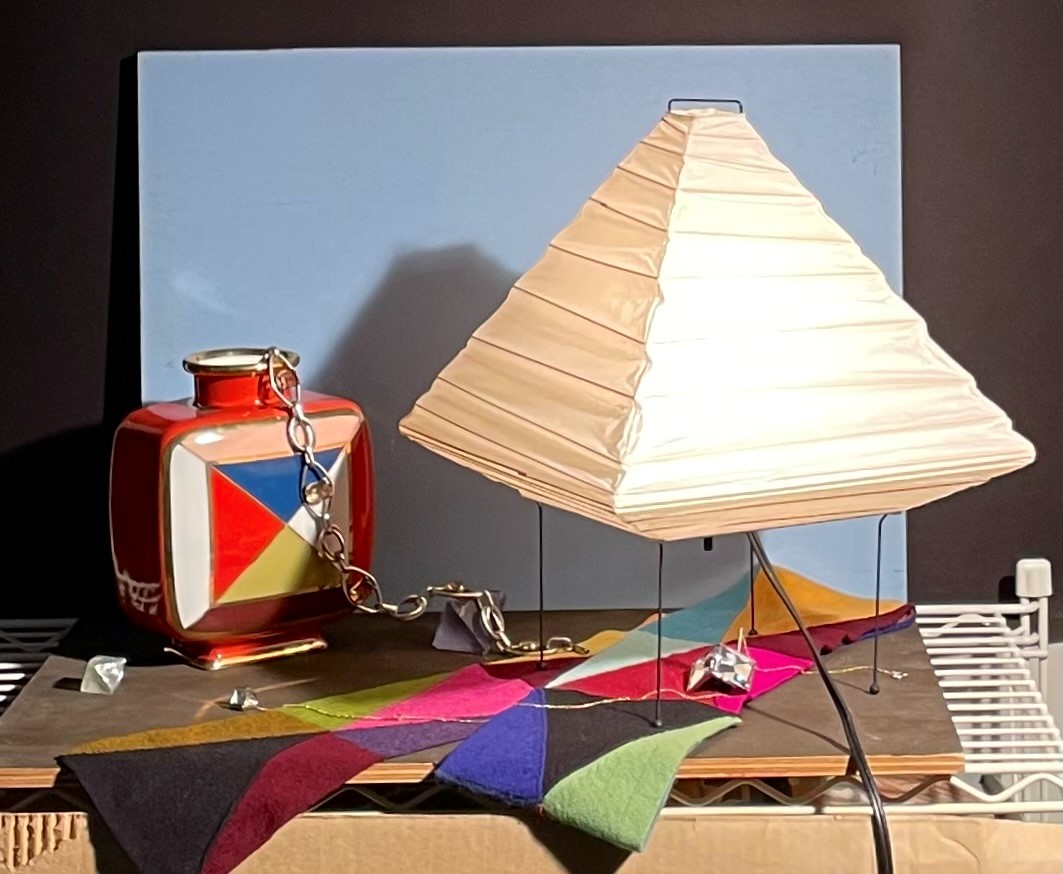
I still wasn’t happy with the scarf, so I tried folding up the other side instead. You can see this below. I liked this better because it interfered less with the vase. In the other position, I thought that it was competing. Finally, I moved the lamp cord into a more pleasing position. The new angle echoes some of the angles in the lamp and looks more harmonious.

This is the final version. The next step is the drawing.

The Color of Shadows and Lights

One of the themes of this painting is cool daylight vs. warm indoor light and the effect it has on the color of shadows and lights. I have a warm spotlight coming in on the right side, and a window on the left, admitting cool daylight. You can see the effect that this has most clearly in the cast shadows of the handbag and straps on the wall. The shadows cast from the spotlight are cool blue. The shadows cast by the daylight are a warm yellow.

To make it easier to see the cool light, below, I turned off the spotlight in the set-up. You can see how all of the lights are now cool, and the shadows warmer. Some of these warm shadows from the window are very light in value and are overpowered by the warm spotlight when it’s turned on. Looking at the set-up this way, however, helps me to see the warm shadows when I turn back on the light.

In the detail below, the framed mirror is casting a warm shadow to its right, on the wall and tabletop. This is created by the cool light coming in the window. Also, the mirror itself is very cool. This is because it is situated entirely in the cool shadow cast by the wall on the right. This is accentuated by the cool light coming in from the window, which gently illuminates it. In addition to these effects, the mirror is reflecting cool highlights into the shadow on the tabletop.

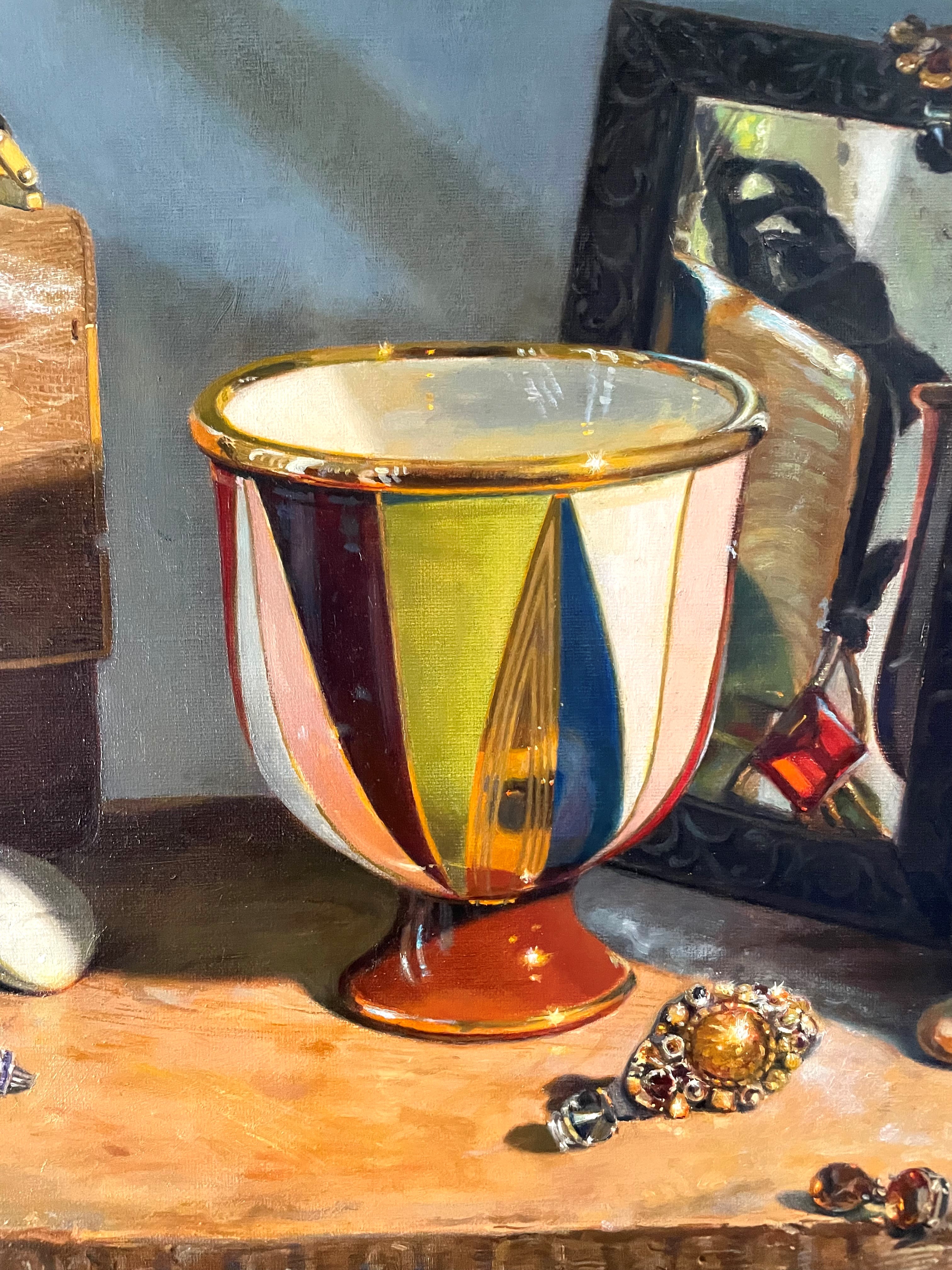
Below, you can see the colors of the lights in the vase. The highlights on the front of the rim on the right side are warm yellow, created by the spotlight. The highlights on the front of the rim on the left are created by the cool outdoor light. Similarly, the white triangular area on the body of the vase on the left side is a very cool blue, while the white triangular area on the right is a warmer yellow. Typically, I wouldn’t use such a strong secondary cool light, because I usually like to have a distinct dark side and light side to any object. You can see that the vase doesn’t have a strongly defined dark side. Having light come from two directions diminishes that effect, but in this case, I really enjoyed the cool/warm contrast, and in this painting, color and light is more important than value contrast.

Below, the cool shadows cast by the necklace onto the cutting board are made cooler and lighter by the cool blue light coming in from the window. You can also see how the transparent red crystal is casting a red shadow.

Throughout the painting, cool and warm lights are mixing. In the detail below, you can see the very warm yellow cutting board with flecks of cool blue light flickering over it.

Painting the Bowl

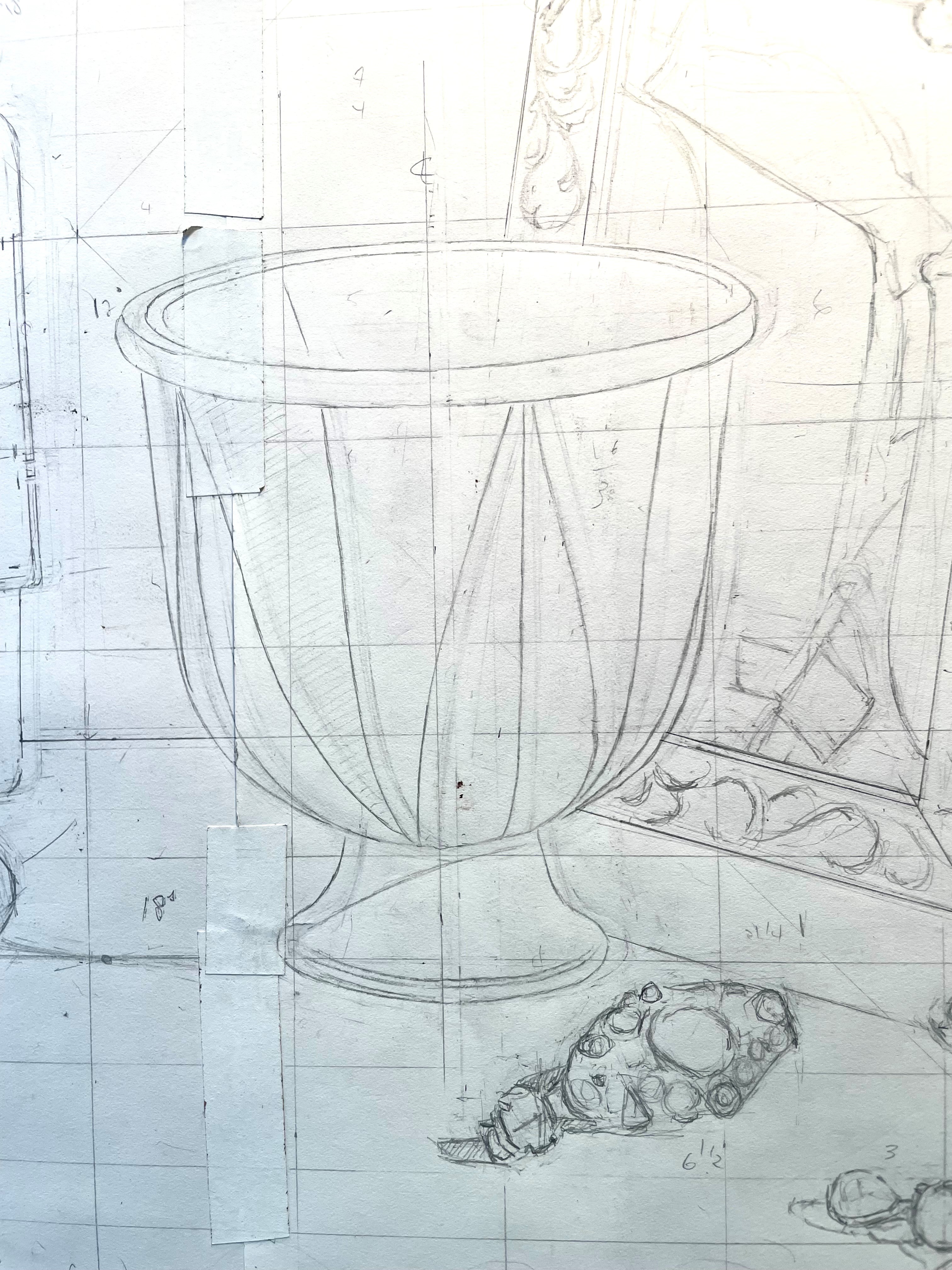
Before I leave on my 3-week Italy vacation, I thought I’d get one more blog post up! Here’s where the work on the bowl started. It was super-hard to get this drawing correct. You can see all of the corrections and erasures. Just when I thought I had it, I’d notice that something was off. Drawing really has to be done over the course of several days, with time between sessions, so that your eye can be refreshed. Too much staring at something distorts your perceptions.

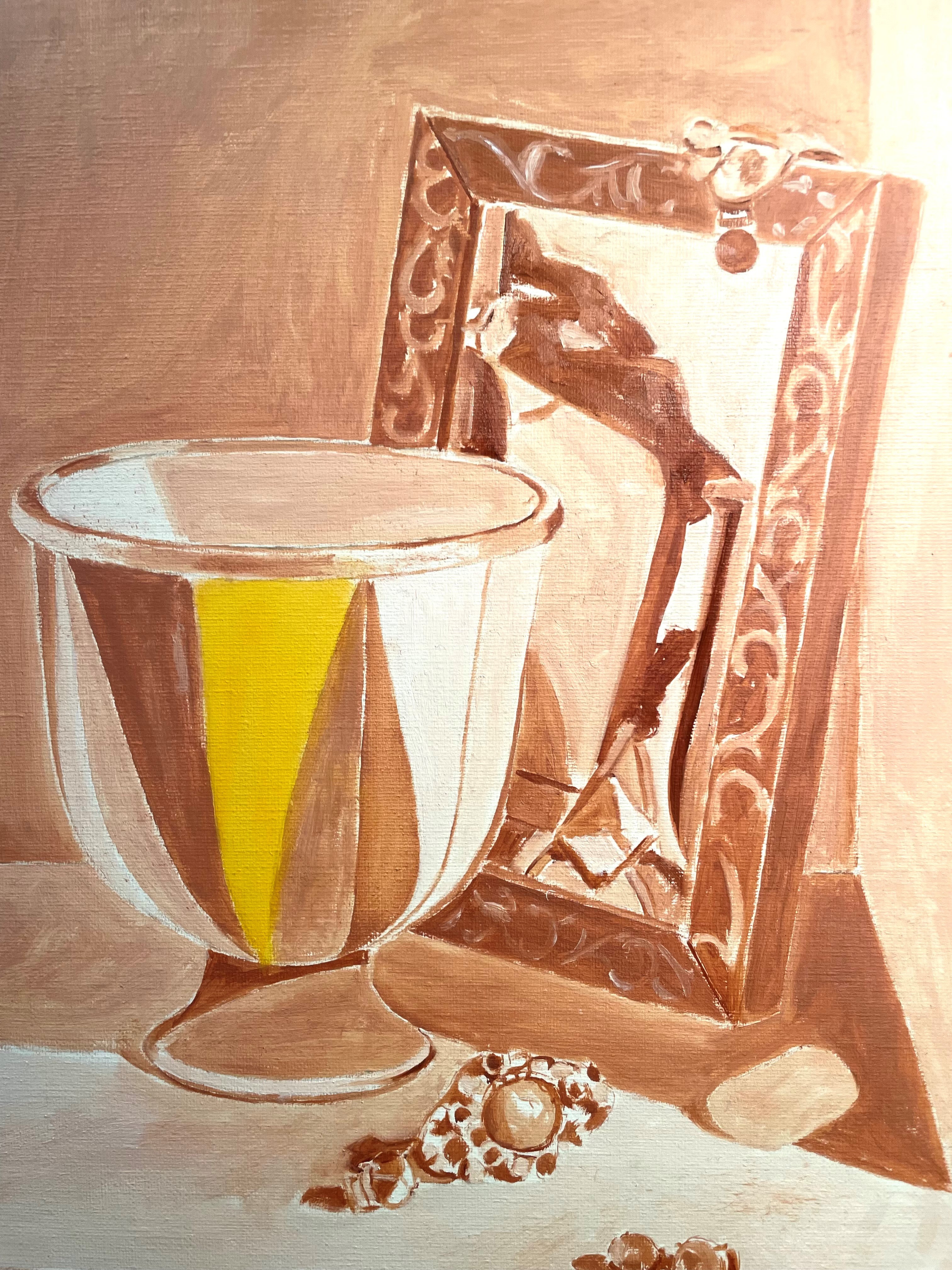
Below is the underpainting, done in lead white and burnt sienna. I painted what will be the green area in cadmium yellow. I plan to glaze over this area in bright green. This makes for a much brighter green than you can achieve with solid paint. The underpainting is much lighter in value than the painting will be. This helps keep the colors brighter and truer. I don’t worry about details or subtlety in the underpainting, because it will all be painted over. It mostly serves to unify the colors and as a guide for the paint that follows.

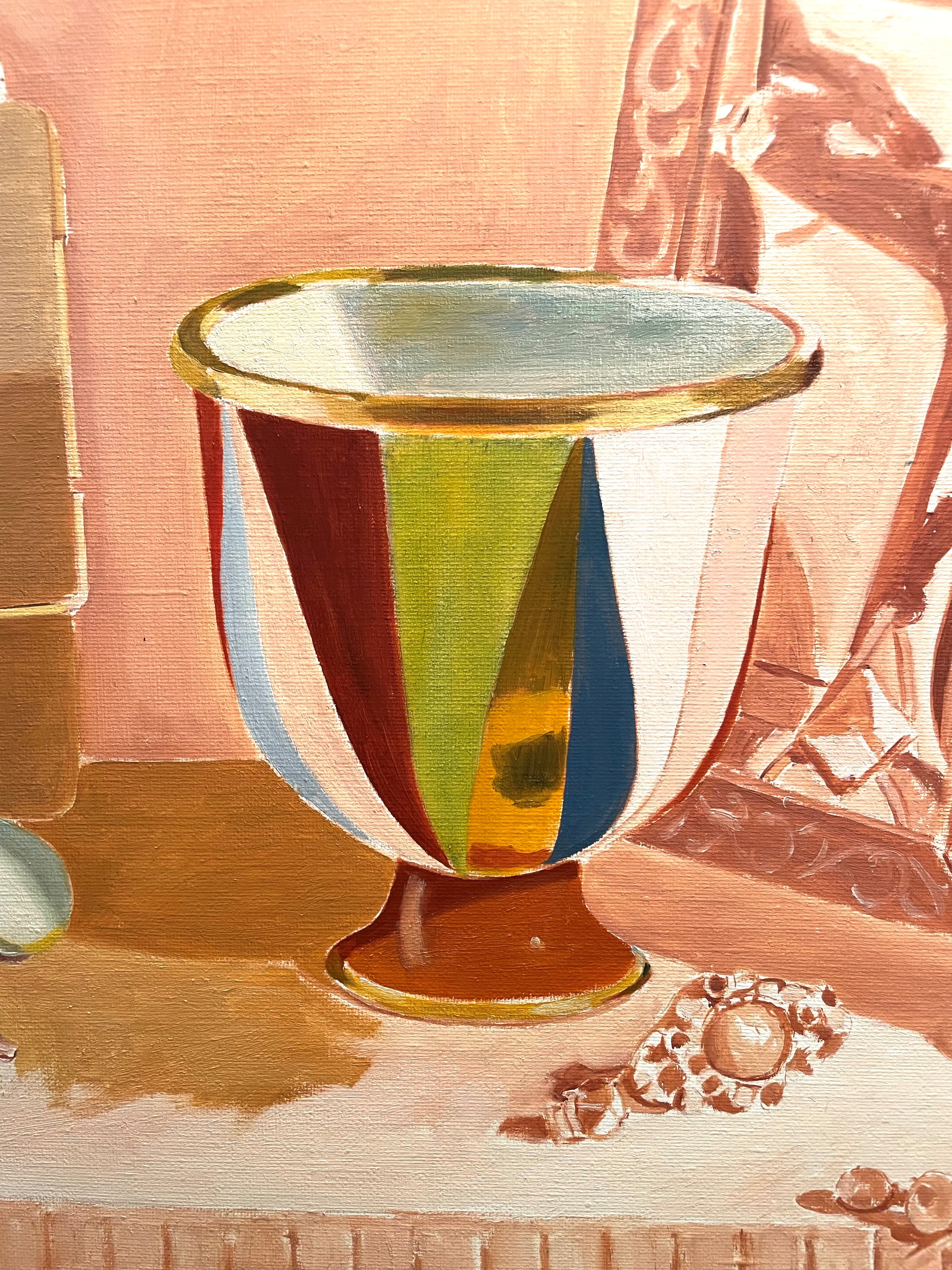
The next step, below, is to paint the local colors in their correct values (still with no nuance or detail). I will end up correcting these values and colors as the painting progresses. When there is more paint down, I’ll be able to compare and make better judgements. You can see the first layer of green glaze over the yellow portion.
Below, I have put down all of the local colors in the surrounding areas, so I can start refining. I glazed the purple section darker, added a bit more detail on the rim, and glazed in the shadow on the base.

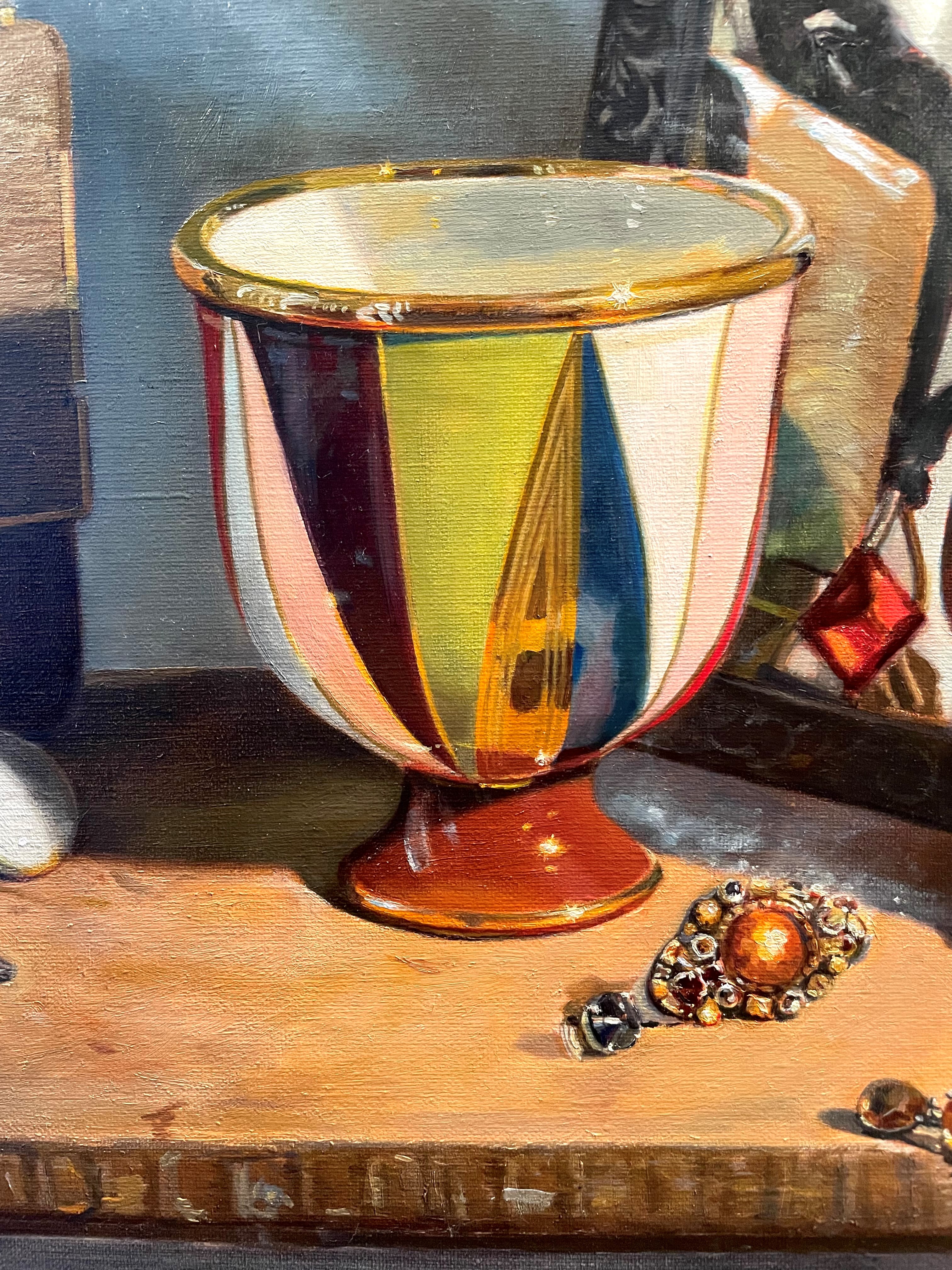
Highlights always come closer to the end. Below, I’ve started to indicate them. I added the stripe detail on the gold section, and the gold dividing lines between sections. I continue to refine the rim. These details were very hard to see. It took a lot of looking! I softened all of the edges on the outlines of the bowl. Curved objects always have a softness to their edges to show that the form continues around.
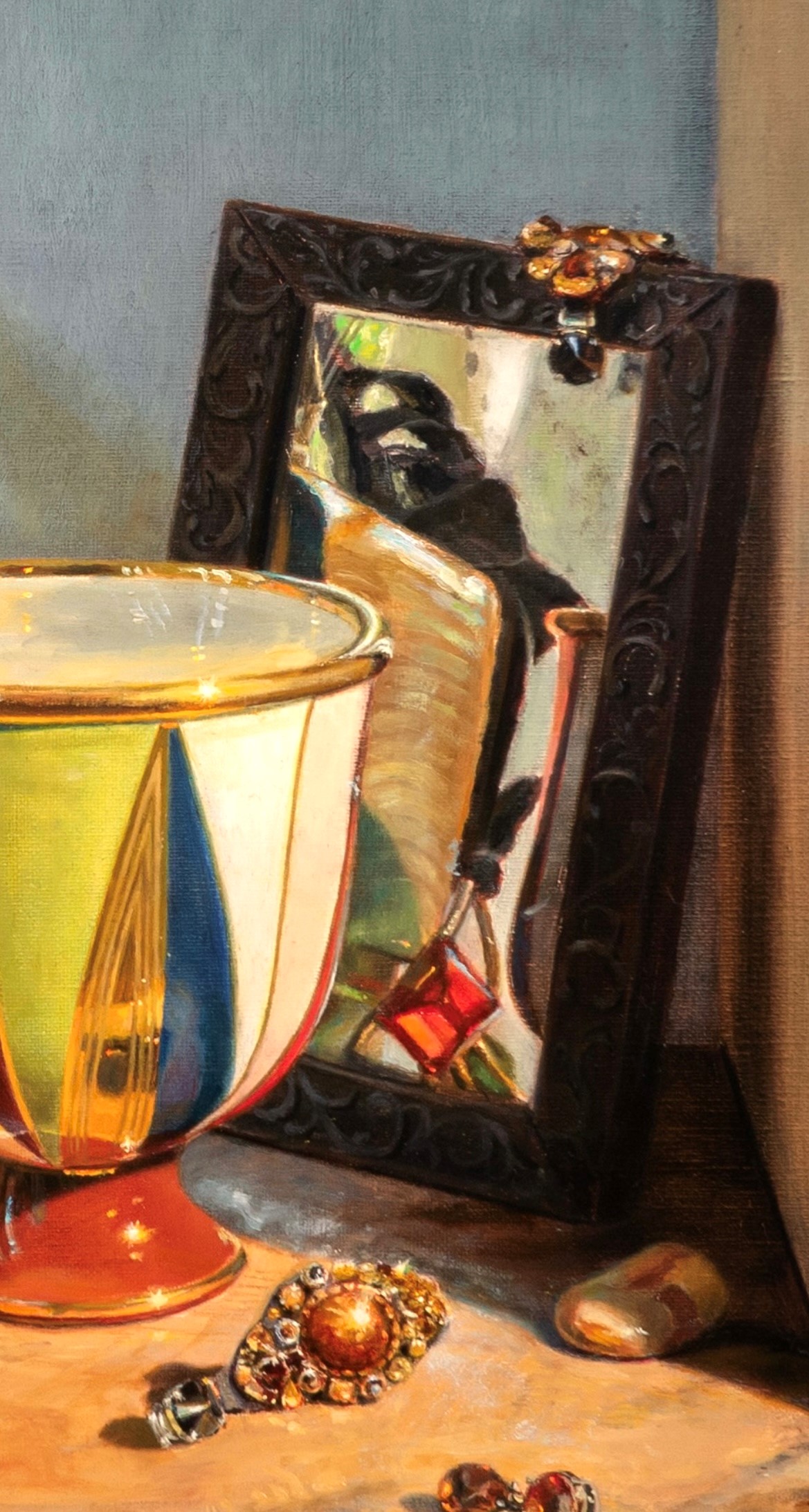
Finally,below, I refined the highlights, and added the subtle reflected lights from the other objects in the set-up.

I’ll be back in mid-October!