I’ve been getting a lot of questions about painting glass lately, so I decided to teach an on-line class on the subject! The class will be a live, 4-session class in mid-January. The details are at https://lindamann.com/class-description if you’d like to join me. Spots are filling up, so sign up soon if you are interested!
For this post, I thought I’d give you a little preview of some of the subjects that I’ll be covering in the class.

Painting glass can be confusing. There are so many complicated shapes and colors in the glass that it’s natural to not understand what you’re looking at and be overwhelmed. You can’t paint what you don’t understand. You also can’t paint unless you can train yourself to really see. The first thing to remember is that when painting transparent glass, you are painting what is behind the glass, altered by the way that glass objects distort forms. Above, you can see the brass box behind the glass decanter. The shapes, however, are curving to follow the shape of the decanter. What at first seems like a lot of confusing shapes, can now be understood and more easily seen and painted. Below, you can see the same phenomenon with the gold lines on the tray being bent when seen through the glass globe.
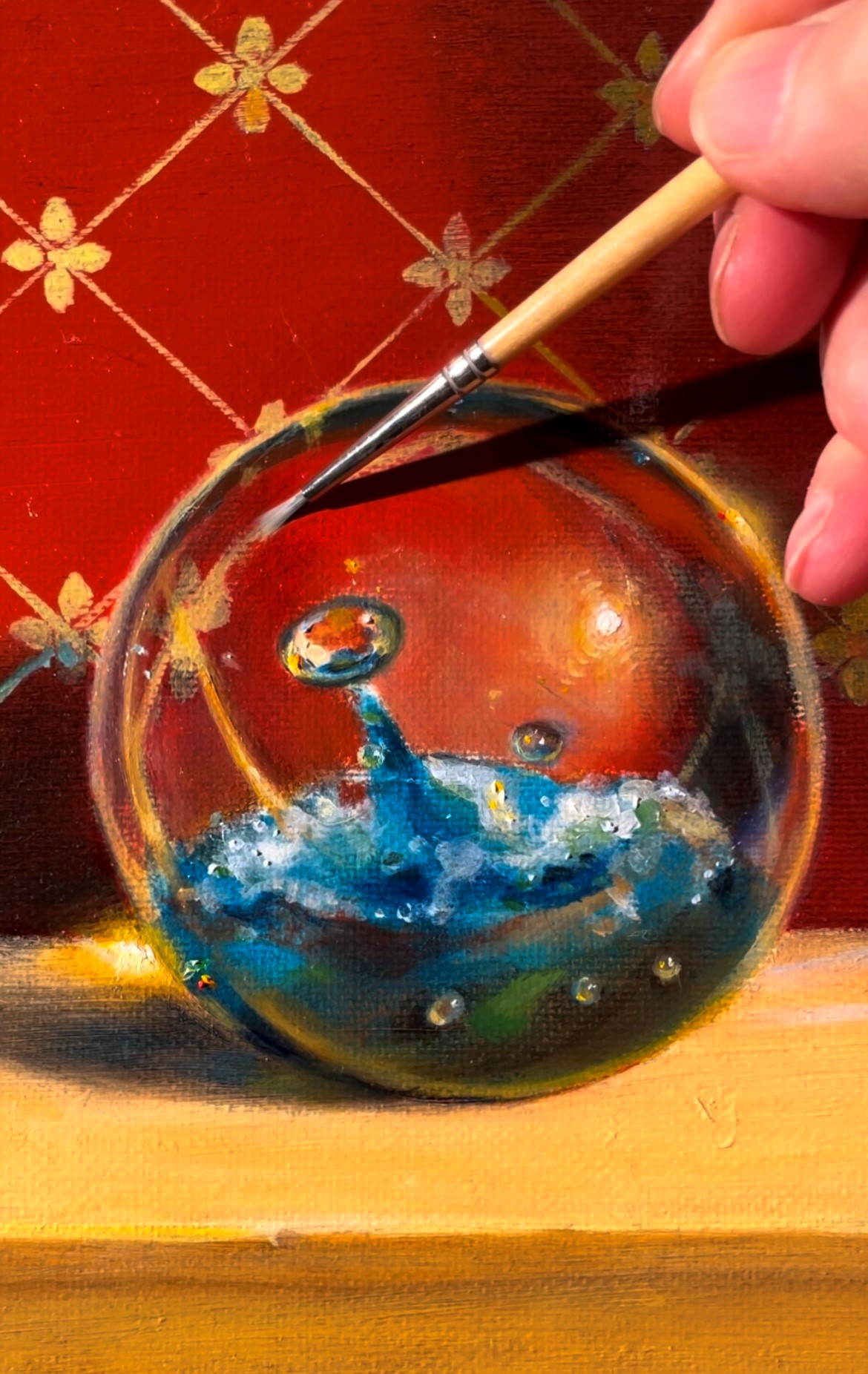
Another useful thing to notice when looking at glass objects is that often the edges are illuminated. See how the outlines of the glass globe are highlighted. You can see that in the image below, too.
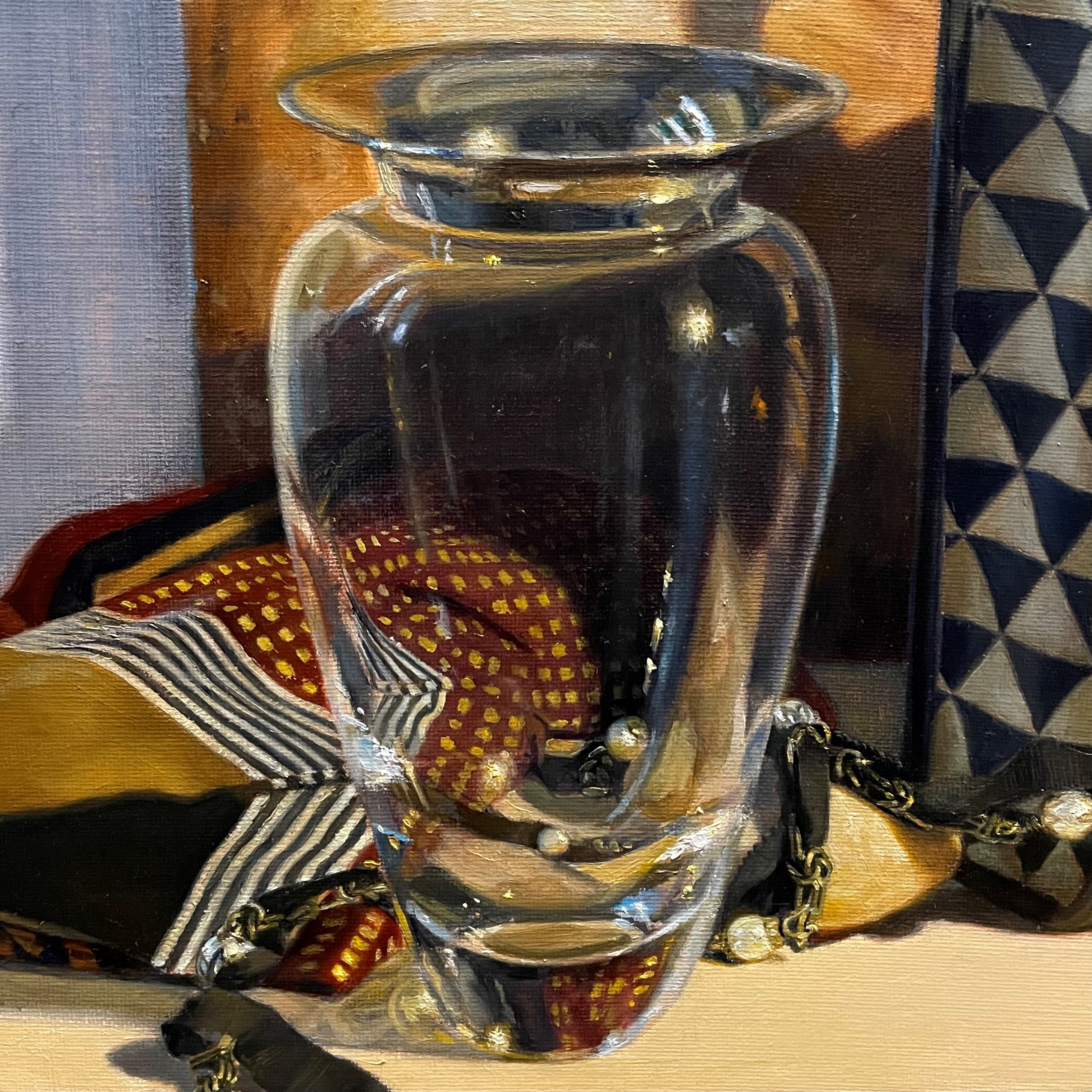
Finally, glass is reflective and acts as a mirror. The triangles in the bag are reflected onto the top right side of the vase, above. Also, the window is reflected onto the vase. It appears as a curving blue line. All reflections follow the form of the object.
These are just a few pointers to get you started thinking. Once you understand how glass behaves, it stops being perplexing and starts to be really fun to see and paint. I hope you can join me and we can paint together.
 Linda Mann Artist